
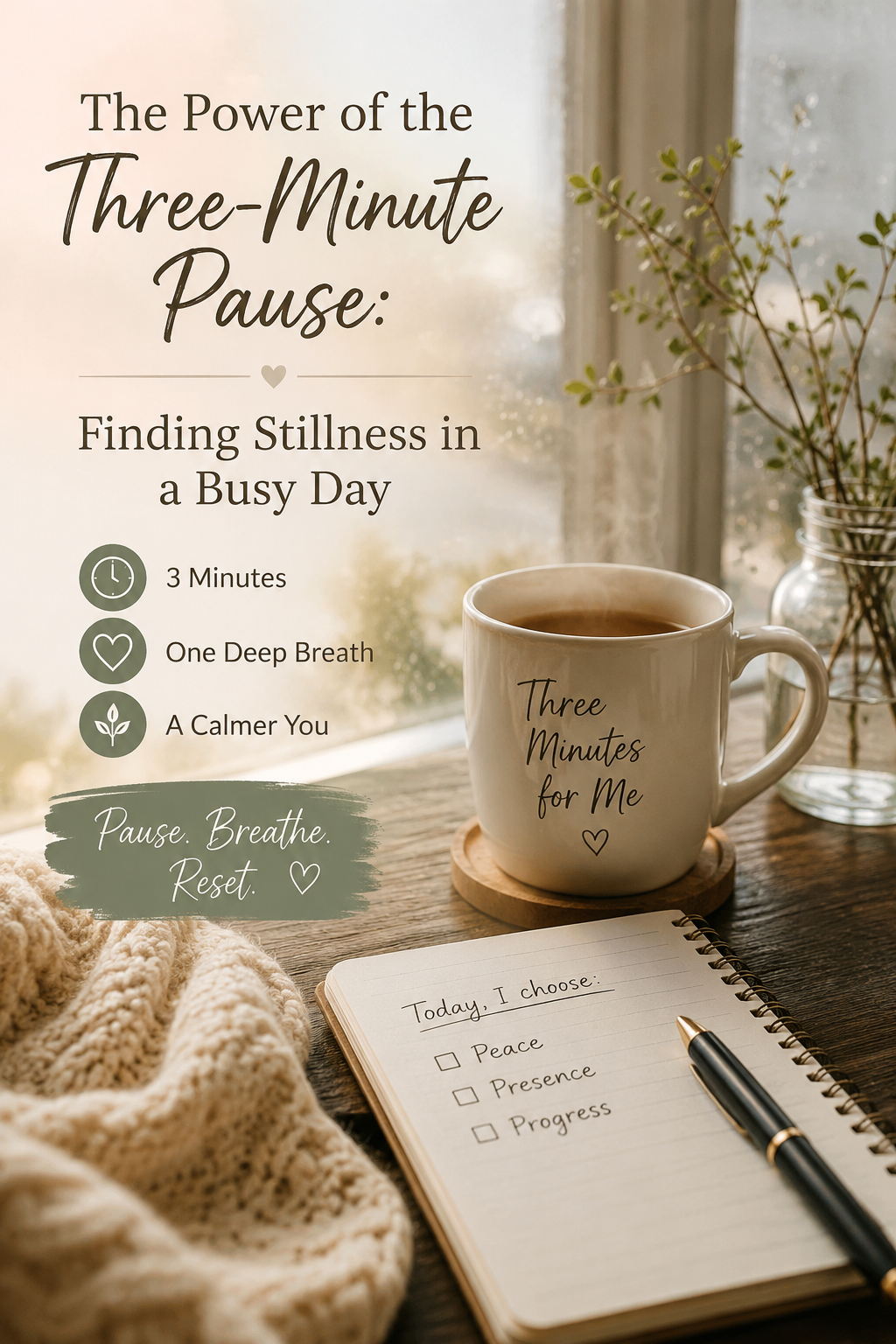
By midday, you may already feel far away from yourself. The morning has been filled with emails, errands, meetings, messages, school drop-offs, decisions, and small interruptions that quietly gather weight. You look at the clock and realize you have been moving for hours without taking a single full breath. Perhaps you tell yourself that you will rest later. After lunch. After this task. After everything is finished. But everything is rarely finished. There is always another message waiting. Another load of laundry. Another tab open in your mind. So what if your midday reset did not need to be an hour? What if it only needed to be a few intentional minutes?
A pause does not need to be earned
Many of us carry the idea that rest comes after productivity. First, you must complete the work. First, you must catch up. First, you must prove that you have done enough. Only then can you sit down with your coffee while it is still warm. But a pause is not a reward for being efficient. It is part of how you remain connected to yourself while moving through an ordinary day. You are not lazy for needing a moment away from the screen. You are not failing because your attention feels scattered. You are not broken because your body is asking for quiet. You are a person living inside a very loud rhythm. A small pause can be a way of softening that rhythm.
What makes a midday pause restorative
A reset does not have to be elaborate. It does not need a special cushion, an app, a journal with the perfect prompts, or a completely empty calendar. It simply needs to create a little distance between you and the demands of the day. A useful pause often includes three gentle elements: A change of place, even if you only move to a different chair. A change of attention, away from work and toward your senses. A small act of care, such as drinking, breathing, stretching, or stepping outside. The most important part is that the pause feels different from the work surrounding it. If you spend your break answering messages while eating lunch, your body may be technically away from the task, but your mind is still standing inside it. Research on micro-breaks supports this simple idea. A 2022 systematic review and meta-analysis found that brief breaks were associated with greater vigor and less fatigue, even though their effects on performance varied depending on the task and the length of the pause. Read the full review in PLOS ONE. You do not need to turn this into another performance project. The point is not to return as a more optimized version of yourself. The point is to return with a little more room inside you.
Begin with a warm drink There is something grounding about holding a warm cup in both hands. The heat arrives before the thoughts settle. The steam rises. The mug gives your hands somewhere to be. Your midday drink can become a small threshold between one part of the day and the next. Make coffee, tea, cocoa, or warm water with lemon. Then, if you can, leave your phone somewhere behind you. Sit near a window. Notice the weight of the cup. Notice the temperature against your palms. Take one sip before deciding what comes next. This is not about drinking mindfully in a perfect way. Your thoughts may still hurry. You may remember three tasks you forgot. You may feel the familiar pull toward your inbox. That is all right. You can notice the pull and return to the cup. Return to the warmth. Return to the small, ordinary truth that you are here. If five minutes feels impossible, begin with two. A pause can still count when it is brief.
Step outside, even briefly The outdoors does not have to mean a long walk through a forest. It might mean standing on a porch. Walking to the end of the block. Sitting on the front step. Looking up from a parking lot and allowing the sky to enter your awareness. A change of scenery gives your attention something new to rest upon. You might notice: The temperature against your skin. The shape of a cloud. The sound of a passing car. The texture of the pavement. The color of one nearby tree. The way light rests on a wall. You do not have to make the walk brisk. You do not have to track the distance. You do not have to turn it into exercise unless movement feels nourishing today. You can simply step outside and let your senses remind you that the world is wider than the screen in front of you. One study included in the PLOS ONE review examined brief views of greenery and found that even a short visual connection with nature may support attention. You can read more about the research on micro-breaks and attention restoration. The practice can be very small. Open the door. Feel the air. Let your eyes travel farther than the next notification.
Breathe without an app Sometimes even a helpful app feels like one more thing to open. One more instruction to follow. One more measure of whether you are doing enough. You can breathe without an app. You can sit in your chair, place both feet on the floor, and notice what your breath is already doing. There is no special pattern you need to force. There is no correct emotional state you need to reach. Try this quiet practice: Let your shoulders lower, if they are willing. Unclench your jaw. Feel your feet against the floor. Notice one ordinary inhale. Notice one ordinary exhale. Allow the next breath to arrive without directing it. Continue for one minute, or a little longer. Your attention may wander. That is not a mistake. You may feel impatient. That does not mean the practice is failing. Breathing is not a test of calmness. It is simply a way to sit beside yourself for a moment. If focusing on your breath feels uncomfortable, let your attention rest on another sensation instead. The hum of the refrigerator. The warmth of your sleeves. The chair beneath you. The sound of water moving through the pipes. Stillness can begin with noticing what is already here.
A five-minute reset for crowded days Some days offer only a small opening. That opening is still worth protecting. You might try this five-minute rhythm: Minute one: Leave the work behind. Close the laptop or turn your screen face down. Set your phone out of reach, if possible. Stand up slowly. Minutes two and three: Change your surroundings. Step outside, move to another room, or stand near a window. Let your eyes soften. Notice three things you can see and two things you can hear. Minutes four and five: Return to one simple sensation. Take a sip of water or tea. Feel your feet on the floor. Breathe naturally. Ask yourself, “What do I need for the next small part of the day?” Not the whole week. Not your entire life. Just the next small part.
A ten-minute reset for a little more space
When you have ten minutes, allow the pause to unfold more slowly. You might spend the first three minutes preparing something warm to drink. Then step outside or walk gently through your home for another three minutes. Use the final four minutes to sit without a screen. You could write a few words in a notebook: What feels noisy right now? What can wait until later? What would make the afternoon feel a little softer? What is one thing that truly needs my attention next? You do not need to solve everything you write down. Reflection is not always about finding an answer. Sometimes it is simply a way to set the fog on the table where you can see it.
When the pause feels impossible
You may be thinking, “This sounds lovely, but I do not have ten minutes.” Perhaps your workday is tightly scheduled. Perhaps you are caring for a child, supporting a family member, or working in a role where stepping away is complicated. Perhaps your midday is already filled with obligations. You are not doing anything wrong. Your pause may need to be adapted to the life you actually have. Try a doorway pause between two tasks. Drink water before opening the next email. Take three slower breaths while waiting for the kettle. Look out the window while your lunch warms. Stand up during a phone call, if that feels possible. Put one hand over your heart while washing a dish. These moments may not look like traditional self-care. They still create a small opening. And small openings matter.
Protect the pause gently
Calling it non-negotiable does not mean becoming rigid. It means allowing your care to have a place in the day before the day takes everything. You might place a recurring reminder on your calendar. You might tell a colleague, “I will be away from my screen for ten minutes and will respond afterward.” You might keep a mug, journal, or sweater near the place where you usually pause. You might pair the reset with something that already happens, such as lunch or the afternoon cup of tea. The goal is to reduce the number of decisions required. And when the pause does not happen, you do not need to begin again with shame. There is no streak to protect. There is no failure to record. You can return at the next available moment. The practice is not perfection. The practice is returning.
Let the afternoon begin again
A midday pause may not erase the difficult parts of your day. It may not make the inbox disappear. It may not resolve the conversation you are carrying or give you unlimited energy. But it can offer a small place to meet yourself again. A warm drink. A little fresh air. One unmeasured breath. A few quiet minutes in which you do not have to produce, respond, improve, or explain. What might change if you stopped waiting for the perfect hour to rest? What if your reset could be as simple as stepping away before you reach the point of exhaustion? What would feel supportive today: warmth, movement, silence, or a view of the sky? You do not need to take the whole day back at once. You only need to make a little room. The world can wait for five minutes. And you are allowed to be there for them.
With warmth and quiet stillness, The Random Coffee Break Team
The Random Coffee Break shares reflections and practical ideas for personal growth and mindful living. Our content is for informational and personal reflection purposes only, not medical or mental health advice. If you are experiencing distress or need professional support, please seek care from a qualified professional.