There is a particular kind of tiredness that comes from being reachable all day.
Your eyes have moved from window to laptop to phone.
Your attention has followed one notification into another small room, then another.
By evening, you may feel full of information and strangely far away from yourself.
Not broken.
Not undisciplined.
Simply screen-weary.
Our devices are part of how we work, learn, care for people, find directions, make plans, and stay connected. You do not have to abandon them to create more quiet in your day.
This is not a digital detox.
It is not a purity challenge.
It is not a test of how little technology you can tolerate.
It is a gentle seven-day invitation to notice where your attention goes, then make a little more room for choosing.
A softer rhythm.
One small practice at a time.
The season of too much input
Some seasons arrive loudly.
The calendar fills.
Work begins to gather momentum.
Messages wait for replies.
News updates, group chats, reminders, recommendations, and endless little invitations ask to be opened.
Even when nothing is urgently wrong, the steady stream can leave your inner world feeling crowded.
You may notice:
- Reaching for your phone before you are fully awake
- Checking an app without remembering why
- Feeling restless during quiet moments
- Carrying work conversations into dinner
- Scrolling when what you really want is rest
- Finding it difficult to settle into one simple activity
These are not reasons to criticize yourself.
They are places to become curious.
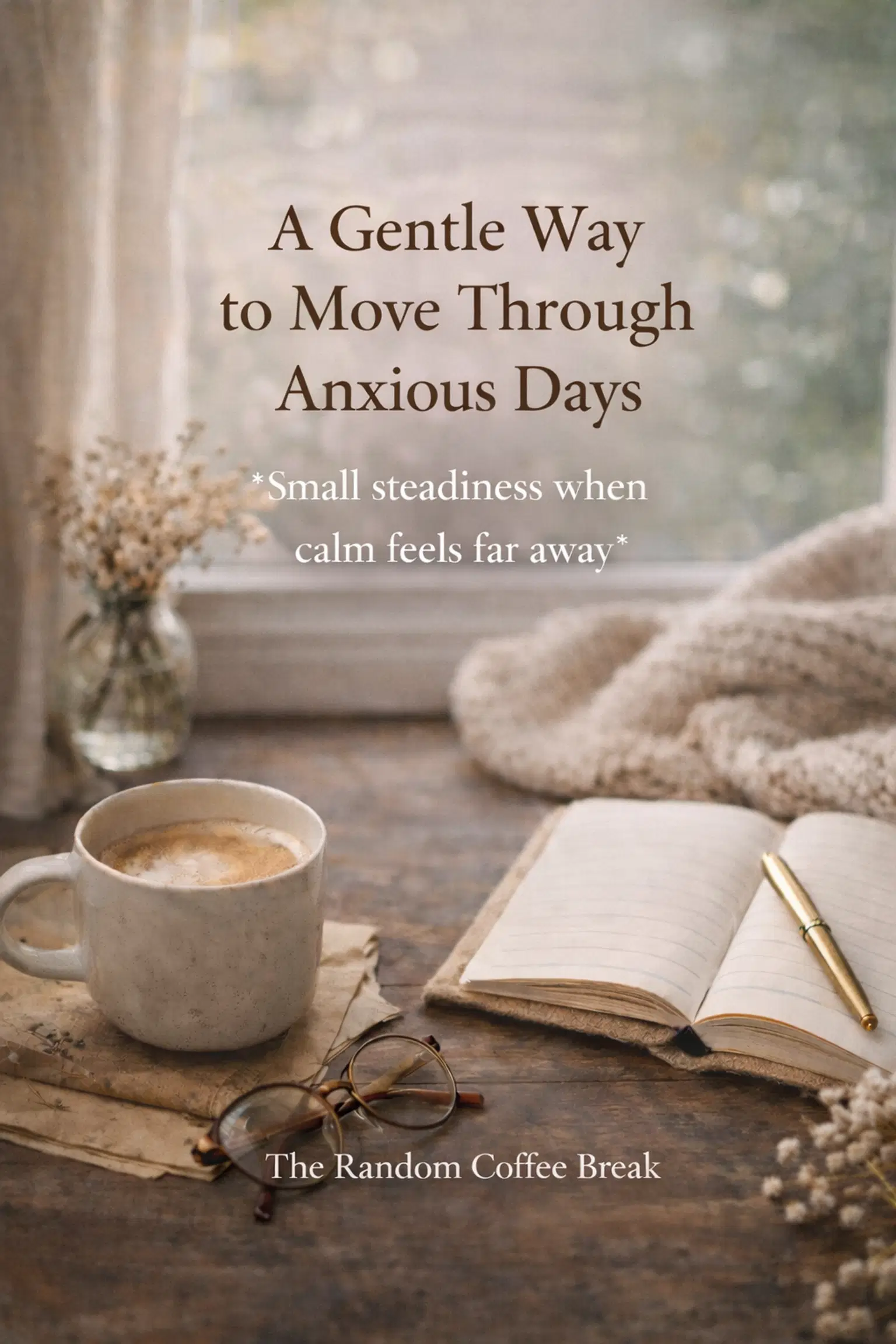
As The Random Coffee Break often returns to, stillness does not need to be dramatic. Sometimes it begins with one breath beside a warm cup of coffee.
The world can wait for five minutes.
Before you begin: make this yours
This week is allowed to be flexible.
If you work on screens, care for children, manage health needs, or rely on your phone for safety and connection, adapt each practice to fit your real life.
You might apply the slow-down mostly to leisure scrolling, social media, news, or unnecessary checking.
You might begin on a Wednesday.
You might miss a day.
You might try one practice twice and leave the others for later.
Nothing has been ruined.
The point is not to become perfectly offline. The point is to create a little more space between an impulse and your response.
A little more quiet inside the noise.
Day 1: Notice the first reach
The first practice is simply noticing.
Not changing.
Not restricting.
Not judging.
Just noticing the first time you reach for a screen in the morning.
Perhaps your hand moves toward your phone before your feet touch the floor.
Perhaps you check the time, then open a message, then read something you did not intend to read.
When you notice the reach, pause for one soft moment.
Ask yourself:
What am I looking for right now?
The answer may be practical.
The answer may be comfort, stimulation, reassurance, or a way to avoid the quiet.
There is no wrong answer.
You do not even have to put the phone down. You are simply bringing awareness to a movement that may usually happen on autopilot.
If it helps, write one sentence in a notebook:
This morning, I reached for my phone because…
Let the observation be enough.
Awareness is already a small reset.
Day 2: Create one phone-free pocket
Today, you are invited to make one small pocket of time that belongs entirely to you.
It could be:
- The first five minutes of your coffee break
- The time it takes to eat lunch
- A short walk to the mailbox
- The few minutes while water boils
- A shower
- The first page of a book
Choose something brief and familiar.
Five minutes is enough.
Place your phone somewhere slightly out of reach, if that feels possible. In a bag. On a shelf. In another room. Face down on the other side of the table.
Then let the pocket unfold without filling it.
Notice the warmth of your mug.
Listen for the refrigerator humming.
Feel your feet against the floor.
Look out of the window without needing to capture the view.
A phone-free pocket does not have to feel deeply peaceful. You may feel bored. You may notice the urge to check.
That is all part of the practice.
You are learning what a small unclaimed moment feels like.
Day 3: Remove one unnecessary notification
A notification can be a very small interruption.
It can also become the first note in a long song of divided attention.
Today, choose one notification that does not need to reach you immediately.
Perhaps it is a shopping alert.
A social media update.
A game reminder.
A newsletter.
A news headline.
You do not need to reorganize your entire digital life. You do not need to turn everything off.
Just one.
Open your notification settings and remove, mute, or quiet that single interruption.
Then notice what changes.
Maybe nothing seems different at first.
Maybe your phone feels a little less expectant.
Maybe you realize there are other alerts you would like to revisit another day.
You can make a note of them and leave them for now.
This is rebuilding through small choices.
Not a wall between you and the world.
A softer doorway.
Day 4: Replace one scroll with a sensory pause
At some point today, notice one moment when you are about to scroll without a clear reason.
You might be waiting for the kettle.
Standing in line.
Sitting in the car before an appointment.
Taking a break between tasks.
Instead of opening an app immediately, try one sensory pause.
Look for three things you can see.
Notice two sounds.
Feel the texture of your sleeve or the chair beneath you.
Take one sip of water and follow it from the glass to your mouth.
Smell the coffee before drinking it.
Listen to the rain, if there is rain.
This does not mean scrolling is bad.
It means you are giving yourself one additional option.
A pause can be very ordinary.
It can be the quiet clink of a spoon against a mug, sunlight on the kitchen counter, or the coolness of a door handle beneath your palm.
Sometimes clarity does not arrive as a grand realization.
Sometimes it arrives through the senses, one small detail at a time.
Day 5: Protect the last few minutes before sleep
The end of the day can be especially tender.
You may have spent hours responding, deciding, solving, and absorbing.
Then the phone comes with you into bed, carrying a few more headlines and conversations into the dark.
Today, consider protecting only the last few minutes before sleep.
Not an hour.
Not a perfect evening routine.
Just five or ten minutes.
Choose a gentle place for your phone to rest while you brush your teeth, change clothes, stretch, or get into bed.
If you need your phone nearby for practical reasons, keep it available and quiet. This practice is about creating a small transition, not making your bedroom into a rule-bound space.
You might place a notebook beside your bed and write:
What can wait until tomorrow?
Or:
What would feel kind to remember about today?
Let the day settle like sediment in a glass of water.
You do not have to solve every thought before sleep.
You are allowed to leave some things unfinished.
Day 6: Reconnect with one offline activity
Today, return to something that does not require a screen.
Keep it small enough to begin without a great deal of preparation.
You might:
- Make soup
- Fold laundry slowly
- Water a plant
- Read a few pages on paper
- Draw without trying to make anything good
- Sit outside
- Bake something familiar
- Listen to music without multitasking
- Write a letter you may or may not send
Choose an activity that gives your hands somewhere to go.
There is something gentle about stirring a pot, turning a page, sweeping a floor, or arranging flowers in a jar. The body remembers a slower pace when it is given a chance to practice one.
You do not need to feel productive.
You do not need to make the activity meaningful.
Let it simply be something you are doing while you are doing it.
This is the rebuilding part of the week.
A return to attention that does not need to be measured, posted, or completed for an audience.
Day 7: Reflect on what felt different
The final practice is not a scorecard.
It is a quiet look back.
Find a few minutes with your journal, a cup of coffee, or a place near a window.
Ask yourself:
- When did my screen use feel intentional?
- When did it feel automatic?
- Which practice was easiest to return to?
- Which moment felt unexpectedly spacious?
- What did I reach for when I did not reach for my phone?
- Did I notice anything about my mornings or evenings?
- What kind of connection do I want more of?
- What could I gently carry into next week?
You may discover that one phone-free pocket helped more than expected.
You may realize that notifications were not the main source of noise.
You may find that you still want your phone nearby, but not in your hand every few minutes.
There is no required conclusion.
Perhaps you choose one or two practices to continue:
- A phone-free coffee
- One quiet notification
- A sensory pause while waiting
- The last five minutes before sleep without scrolling
- One offline activity each week
Let the habits become familiar slowly.
Taking the slow-down home
A digital slow-down is not about becoming a different kind of person.
It is about making room for the person already here.
The one beneath the tabs, alerts, updates, reminders, and open conversations.
The one who may still be tired.
The one who may need quiet before they know what quiet is for.
You can begin again whenever you need to.
Tomorrow morning.
After a busy weekend.
In the middle of a long workday.
With one notification.
One breath.
One small pocket where your attention comes home.
For more gentle practices around stillness, reflection, and rebuilding, you can visit The Random Coffee Break blog or return to this quiet reflection on reconnecting with the parts of yourself that deserve your attention.
You do not have to step away from the whole digital world today.
Just notice where you can soften the edges.
Take what you need.
Until the next quiet cup,
The Random Coffee Break