Cozy warm workspace with a hot mug of coffee and beautiful view
Freshly Brewed Thoughts

The Blog

Freshly brewed thoughts for the weary soul.

Mindfulness isn’t about perfection. It’s about noticing — the warmth of your cup, the steadiness of your breath, the way this moment is enough.

The Desk Reset: 5 Micro-Pauses to Calm Your Nervous System Between Meetings
Mindfulness by coffee

The Desk Reset: 5 Micro-Pauses to Calm Your Nervous System Between Meetings

There is a particular kind of tiredness that comes from moving directly from one obligation to the next. A meeting ends. Another begins. Your inbox waits in the background. Your phone glows beside your keyboard. A dozen unfinished thoughts follow you from one screen to another. Even when your body is sitting still, some part of you may still be rushing. This is the season many of us are living through. A season of full calendars, constant connection, and very little space between things. You are not wrong for feeling scattered. You are not broken because it takes time to come back to yourself after a difficult conversation, a crowded class, a creative deadline, or a long morning of video calls. Sometimes, you simply need a small doorway between one moment and the next. That is what a desk reset can be. Not a full meditation session. Not an elaborate wellness routine. Just a few quiet seconds to soften the edges of the day.

A pause is not lost productivity

Hustle culture teaches us to treat every empty minute as a problem to solve. If a meeting ends early, we fill the space. If we finish a task, we immediately search for the next one. If our attention wanders, we judge ourselves and push harder. But a pause is not laziness. It is not a sign that you are falling behind. A pause gives you the chance to notice what you are carrying before you carry it into the next room, the next email, or the next conversation. At The Random Coffee Break, we believe in softer rhythms. The kind that leave room for breath. The kind that allow your mind to settle before asking it to produce again. You can read more about bringing this approach into your workday in How to Integrate Slow Living With Your 9-to-5. For now, consider these five micro-pauses. Each one can take less than two minutes. Each one can happen quietly, even when your calendar is full.

1. Soften your gaze

Screens ask a lot from your eyes. They also ask a lot from your attention. When you move from one bright window to another, your focus can become narrow and fixed. The world shrinks to a rectangle. Your breath may grow shallow without you noticing. Between meetings, invite your eyes to widen. Look away from the screen. Choose something farther away, such as a window, a wall, a plant, or the corner of the room. Let your gaze rest there without studying it. You do not need to name every detail. You do not need to make anything happen. Simply allow your vision to take in more of the space around you.

You might notice:

  • The soft edge of morning light on the wall
  • A shadow beneath your desk
  • The shape of a mug near your hand
  • A color you had stopped seeing
  • The gentle movement of curtains or leaves

Let your eyes become less like searchlights and more like open windows. Stay for three slow breaths, or for the length of one natural exhale. Then return to the screen when you are ready. This small shift can feel like stepping out of a narrow hallway and into a room with more air.

2. Release the body

Your body may have been holding the meeting long after the meeting ended. The jaw that tightened during a difficult question. The shoulders that slowly climbed toward your ears. The hands that stayed curled around a mouse or pressed into the edge of the desk. Before opening the next tab, offer your body a quiet check-in.

You might ask: Where am I bracing?

There is no need to correct yourself harshly. Just notice. Then begin with the simplest release available. Let your shoulders drop. Unclench your hands. Allow your tongue to rest more softly in your mouth. Feel both feet meet the floor. If it feels comfortable, roll your shoulders slowly once or twice. Stretch your fingers. Turn your head gently from side to side. Move as though you are making room inside yourself. Not forcing. Not stretching toward discomfort. Just loosening the places that have been working hard. You might imagine setting down a heavy bag you forgot you were carrying. The goal is not to create a perfect posture or produce a particular physical response. This is simply a grounding practice. A way to listen to the body before it has to speak louder.

3. Orient to the room

After a demanding meeting, your mind may remain inside the conversation. You may replay what you said. Wonder whether you were understood. Try to predict what happens next. This is one way mental fog gathers. The meeting has ended, but your attention is still there. Orienting is a gentle invitation to return to the room you are actually in. Look around slowly. Notice where you are.

You might silently name:

  • Three things you can see
  • Two sounds you can hear
  • One place where your body is supported

Perhaps there is the low hum of an air conditioner. The faint sound of someone typing. A chair beneath you. The floor beneath your feet. The familiar shape of your desk. Let your senses remind you that this moment is different from the one before it. You are here. The conversation is over. The next task has not yet asked anything of you. There is only this room, this breath, and the small space between commitments. If naming things feels too structured, simply let your attention wander through the room. Notice light. Notice texture. Notice distance. Let the world become three-dimensional again. This practice can be especially welcome after long stretches of screen time, when the mind feels caught in a loop of tabs, messages, and imagined future problems.

4. Take a mindful sip

A drink can become a small anchor in the middle of a busy day. Coffee. Tea. Water. Whatever is already within reach. Before taking the next sip, pause long enough to meet it. Notice the temperature of the cup against your hand. Feel its weight. Take in the scent. Then drink slowly enough to notice the taste. Warmth. Bitterness. Sweetness. Clean, cool water. Let the sip be an experience rather than something you consume while reading three messages. You do not have to turn it into a sacred ceremony. There is no perfect way to drink mindfully. You are simply allowing one ordinary action to hold your full attention.

You might ask: What does this moment feel like before I move on from it?

Take one sip. Or two. Then notice whether you feel even slightly more present. A mindful sip will not solve a crowded schedule. It may, however, give you a small point of steadiness. Sometimes steadiness begins with something as simple as warmth in your palms. For more small, accessible moments like this, visit The Daily Sip, our collection of brief centering reflections and quiet practices.

5. Create a small transition ritual The final pause is about marking the space between things. Without a transition, one meeting can blur into the next. One task can remain open in the background while another begins. Your mind keeps several doors ajar at once. A transition ritual gives one door a gentle closing. It can be very small.

You might:

  • Write down one unfinished thought
  • Close the meeting window
  • Clear one item from your desk
  • Turn your notebook to a fresh page
  • Take one breath before opening the next task
  • Say quietly, “That is complete for now”

Then choose one simple intention for what comes next. Not a large goal. Not a demand to be your most productive self.

Just one direction.

For the next few minutes, I will read the document. For this meeting, I will listen before responding. For this study block, I will begin with the first question. For this creative hour, I will make room for a rough beginning.

A transition ritual helps your attention arrive gradually. It gives your mind something clear and kind to hold. You are not asking yourself to leap from one obligation into another. You are walking across a small bridge.

How to build the practice

You do not need to use all five pauses every time. That could become another task to manage. Instead, notice what kind of moment you are in. If you feel visually tired, soften your gaze. If your body feels tight, release your shoulders, hands, and jaw. If your thoughts are looping, orient to the room. If you feel hurried, take a mindful sip. If your day feels fragmented, create a transition ritual. You can also choose one pause to practice for a week. Perhaps you soften your gaze after every video call. Perhaps you place your feet on the floor before opening your inbox. Perhaps the end of each meeting includes one written sentence about what comes next. Small repetitions matter. The practice becomes familiar. The doorway becomes easier to find.

Take it home

A desk reset does not have to stay at your desk. You can use the same rhythm when you arrive home after work. Before stepping out of the car. Before picking up your child. Before beginning dinner. Before replying to a message that has stirred something in you. Soften the gaze. Release the body. Orient to the room. Take a mindful sip. Create a small transition ritual. The world may still be loud when you finish. Your schedule may still be full. But you have given yourself a place to return. And returning is a practice. Not a performance. Not another way to become more efficient. A quiet way of remembering that you are a person before you are a worker, student, caregiver, creator, or problem-solver. You are allowed to take a breath between things. You are allowed to arrive slowly. What might change in your day if you stopped treating every pause as an interruption and began to see it as part of the rhythm? The next time a meeting ends, notice the space before the next one begins. Let it be small. Let it be enough.

Take what you need.

Until the next quiet cup, The Random Coffee Break

The 2-Minute Savor: How to Meditate When You Can’t Sit Still
Mindfulness by coffee

The 2-Minute Savor: How to Meditate When You Can’t Sit Still

You sit down to meditate, and suddenly remember the email you forgot to send. Your foot begins to tap. Your mind opens twelve small tabs at once. You wonder whether you are doing it wrong. You are not. You are not broken, distracted beyond repair, or somehow less capable of mindfulness because your thoughts are loud. Sometimes, your body is simply carrying a lot. And meditation does not have to begin with an empty mind or a perfectly quiet room. It can begin with a warm cup between your hands. A patch of sunlight on the floor. The familiar sound of rain against the window. A small experience that gives you somewhere gentle to return.

Name the season you are in

Perhaps this is a season of full calendars and unfinished thoughts. A season of changing routines, new responsibilities, crowded inboxes, or trying to remember what day it is. Perhaps you are moving between work, school, caregiving, creative projects, and the many invisible tasks that keep a life going. In a season like this, the idea of meditating for twenty minutes can feel less like an invitation and more like another obligation. So let us soften the doorway. You do not need to become a different person before you begin. You do not need to stop being restless. You do not need to perform calm. Meditation is not a test of how long you can sit without moving. It is not a demand that you empty your mind. It is the quiet practice of noticing where your attention has gone and gently welcoming it back. Again and again. Without scolding yourself. A two-minute savor is one way to practice this in the middle of an ordinary day. It is short enough to fit between two tasks. Simple enough to try with no special equipment. Flexible enough to happen standing, sitting, or moving slowly through your kitchen.

Reset with one ordinary thing

The practice begins by choosing one sensory experience. Not the most meaningful experience. Not the most beautiful one. Just something that is already here.

You might choose:

  • The warmth of coffee, tea, or cocoa
  • The color and shape of a familiar mug
  • Sunlight resting on a wall
  • The sound of a fan, kettle, or passing cars
  • The feeling of your feet inside your socks
  • The scent of soap, coffee grounds, or fresh air
  • The first two bites of a meal
  • The texture of a blanket beneath your hand

The point is not to force yourself into appreciation. You do not have to decide that the moment is wonderful. You only have to become curious about it. What is happening here, right now? If you are using a warm drink, let the cup become your small place of return. Notice its weight in your hands. Notice the temperature. Notice the steam, if there is any. Notice how the light touches the surface. For two minutes, you are not required to improve the moment. You are simply allowing yourself to be with it.

Build the 2-Minute Savor

You can set a gentle timer if that helps. Or you can let the practice last for the length of a few breaths. There is no need to make it exact. Two minutes is a doorway, not a rule.

1. Arrive as you are

Stay in the position your body is already choosing. You may sit at the table. You may stand by the counter. You may lean against the wall or take a slow walk around the room. Let your eyes remain open if closing them feels uncomfortable. Let your shoulders lower by the smallest amount. Allow your jaw to soften, if it wants to. Take one easy breath. Not a dramatic breath. Just a breath that reminds you that you have arrived.

2. Choose one sense Pick a single anchor for this short practice. If you are holding a drink, you might begin with touch. Feel the warmth through the ceramic. Notice where your fingers meet the handle. Observe whether the cup feels heavy, light, smooth, or slightly rough. Then move toward another detail, such as scent or taste. If you have chosen sunlight, notice its shape. Is it bright or muted? Still or changing? Does it fall across the floor, a table, or the sleeve of your sweater? If you have chosen sound, listen without needing to name everything. There may be a hum. A bird call. A door closing somewhere nearby. A small pause between sounds. Let the sound come toward you rather than reaching for it.

3. Stay with the detail For the next minute or so, let your attention rest on what you have chosen. You might silently describe what you notice. Warm. Bitter. Soft. Fading. Steady. Moving. You are not trying to create a special feeling. You are simply giving the present moment a little more room. If you are savoring a drink, take one small sip. Notice the temperature as it enters your mouth. Notice the flavor before your mind compares it with anything else. Notice the moment the taste fades. Then, if you like, take another sip. Slowly. As though there is nowhere else you need to be for these few seconds.

4. Welcome the wandering mind

Your mind will wander. It may wander toward a conversation from yesterday. It may begin planning dinner. It may remind you of something you need to buy, finish, answer, or repair. This does not mean the practice has failed. The noticing is part of the practice.

You might quietly say:

  • Thinking
  • Planning
  • Remembering
  • Worrying
  • Listening

Then return to the warmth of the cup. The sound in the room. The sunlight on the wall. The feeling of your feet. This returning is the meditation. Not the perfect focus before the distraction. The returning. And the returning again.

5. Close without rushing away

When the two minutes are complete, notice one detail you would have missed if you had stayed on autopilot. Perhaps the drink was warmer than you expected. Perhaps the light had moved. Perhaps the room was not silent, but your attention had become quieter. Perhaps nothing felt different at all. That is allowed, too. Take one final breath. Let the practice end without turning it into a performance review. You do not have to ask whether you were calm enough. You showed up. That is enough for today.

Permission to adapt the practice

Stillness does not have to look like sitting perfectly still. For some people, movement makes attention more available. You might savor the sensation of washing one dish. Feel the water across your hands. Listen to the small sound of the stream. Notice the weight of the plate as you place it on the rack. You might take a slow walk to the mailbox and let your feet become the anchor. Left foot. Right foot. The movement of your arms. The air against your face. You might keep both eyes open and choose one object to observe while you wait for a page to load. The corner of a plant leaf. The grain of your desk. A photograph on the wall. There is no single correct posture. There is only a posture that helps you remain present and safe. If you are driving, operating equipment, or moving through a situation that requires your full attention, wait until you can pause safely. And if a sensory focus feels uncomfortable, you can choose another one. A practice is meant to support you, not trap you.

Take the pause home

The two-minute savor is small on purpose. Small practices are easier to carry.

You might connect yours to something that already happens each day:

  • After you pour your morning drink
  • Before opening your first work message
  • When you return home
  • While waiting for water to boil
  • Before beginning your evening routine
  • After brushing your teeth
  • When you notice yourself reaching for your phone without knowing why

The cue does not need to be perfect. It only needs to be familiar. Over time, the practice may become less about finding two uninterrupted minutes and more about recognizing the moments that are already asking for your attention. The steam above the cup. The quiet click of a closing door. The feeling of clean sheets. The last light in the kitchen. These moments are not grand enough to impress anyone. They do not need to be. They are small places where you can meet yourself again. If you would like another gentle place to begin, The Daily Sip offers short centering reflections for ordinary days. You might also explore our earlier meditation for beginners reflection when you feel ready for a slightly longer practice.

For now, you might ask yourself:

  • Where in my day is there already a little warmth?
  • What sound have I been moving past?
  • What would it feel like to give one ordinary moment my full attention?

You do not have to quiet the whole world. You do not have to quiet your whole mind. Just notice one thing. Stay with it for a breath. Then another. The world can wait for two minutes.

Until the next quiet cup, The Random Coffee Break

This reflection is for educational and personal reflection purposes only. It is not a substitute for medical or mental health care. If meditation brings up distress, you are welcome to stop and seek support from a qualified professional.

September Is the Real New Year: 5 Ways to Reset Without Adding to Your Plate
Mindfulness by coffee

September Is the Real New Year: 5 Ways to Reset Without Adding to Your Plate

January arrives with bright promises. New calendars. New goals. New versions of ourselves waiting to be built. September feels different. The light begins to soften. The mornings carry a little more structure. Notebooks appear in bags. Calendars fill again. Even if you are long past school, there can be something familiar about this seasonal turning. A quiet sense of beginning. For many of us, September feels more like the real New Year because it carries the memory of returning. Returning to classrooms, routines, projects, and one another. Returning from the looseness of summer to a rhythm that asks us to gather ourselves gently. Behavioral scientists sometimes call this feeling the fresh start effect. A new season, month, week, or birthday can create a psychological pause between what has been and what might unfold next. You can read more about the research behind that idea in this overview from Psychology Today. But a fresh start does not have to mean a complete reinvention. You do not need a new planner, a stricter routine, or a five-step plan for becoming unrecognizable by October. You are not behind because January’s intentions changed shape. You are not broken because summer was tiring, scattered, or not quite what you hoped it would be. September can simply be a doorway. A place to pause. A place to notice what would make the coming season feel a little more supportive. And perhaps, a place to begin again without adding more weight to an already full plate.

A gentler kind of reset

Our recent reflections on back-to-school rhythms and slowmaxxing have been circling a similar truth. The softer life is not built by collecting more habits. It is shaped by paying attention to what is already here. Sometimes the most meaningful reset is subtractive. You remove one source of noise. You loosen one expectation. You make a small corner of the day easier to inhabit. The following five invitations are not assignments. They are places to begin listening.

1. Pause and notice before you change anything

The first step of a September reset can be doing less. Before you make a list of what to improve, take a quiet moment to notice how you are actually arriving at this season. Perhaps you sit near a window with coffee. Perhaps you take a slow walk after dinner. Perhaps you write a few lines while the dishes dry beside you. There is no need to make the moment beautiful or profound. You are simply creating enough stillness to hear yourself beneath the noise.

You might ask:

  • What has felt nourishing lately?
  • What has felt heavier than it needs to?
  • Where have I been rushing?
  • What am I quietly longing for?
  • What would I like to experience more often this fall?
  • What am I ready to place down?

Try to answer without turning your reflection into a performance review. You do not need to prove that you used summer well. You do not need to explain every unfinished goal. This is only a check-in. A hand placed gently over the heart of your daily life. If journaling helps you listen, you might make this a five-minute practice. Our quiet reflection on returning to the parts of yourself you may have set aside can offer another place to begin.

2. Clear one small source of friction

A reset does not always require adding something new. Sometimes it means making one existing thing less difficult. Think of the small irritations that greet you regularly. The charger that is always missing. The overflowing inbox you avoid opening. The chair covered in clothes. The kitchen counter that never quite becomes clear. The phone that rests beside your bed and pulls you into the day before you have found your breath. You do not have to organize your whole home or create a perfect digital system. Choose one small source of friction. One. Then soften it. You might place your keys in the same bowl each evening. Unsubscribe from five emails. Move distracting apps off your home screen. Keep your journal beside your coffee maker. Put tomorrow’s clothes on the back of a chair. The goal is not control. It is kindness toward your future self. A little less searching. A little less deciding. A little more room to move through the morning without immediately feeling behind. What is one repeated inconvenience you could make 10 percent easier? That may be enough for today.

3. Choose a soft intention Goals often arrive wearing heavy shoes. They ask you to measure. To optimize. To become more disciplined, more focused, more productive, more everything. An intention can feel different. It is less like a finish line and more like a direction. Instead of asking, “What do I need to accomplish this season?” you might ask:

How do I want to feel while I move through it?

Your answer could be:

  • Spacious
  • Present
  • Steady
  • Rested
  • Curious
  • Connected
  • Less hurried
  • More honest

Choose one word or phrase that feels like a small lamp in the window. Let it guide you without becoming another standard you can fail to meet. If your intention is steadiness, perhaps you pause before answering a message. If it is presence, perhaps you leave your phone in another room during one meal. If it is rest, perhaps you stop treating every open evening as an opportunity to catch up. If it is connection, perhaps you send one thoughtful message each week. A soft intention does not demand that every day reflect it perfectly. It gives you something to return to. Like returning to the warmth of a mug between both hands. If you would like a little structure for this kind of reflection, our Gentle Roadmap for Intentional Goal Setting offers a slower way to move from listening into action.

4. Restore one supportive rhythm Summer can loosen the edges of the day. That can be beautiful. It can also leave you feeling as if your sleep, meals, work, and rest are floating in separate directions. When September arrives, you may not need a brand-new routine. You may simply need to restore one rhythm that used to support you. Not all of them. One. Perhaps it is a gentle bedtime window. Perhaps it is eating lunch away from your desk. Perhaps it is a Sunday morning walk, a weekly grocery rhythm, or ten minutes of quiet before checking notifications.

You might begin with an anchor that already belongs naturally in your day:

  • The first sip of coffee
  • The moment you close your laptop
  • The time you brush your teeth
  • The walk from your car to the door
  • The few minutes before sleep

Attach a small moment of awareness to that existing point. When the coffee brews, notice the light. When the laptop closes, take one full breath. When you get into bed, allow the day to be finished for now. This is how sustainable habits often unfold. Not through force. Through returning. The Daily Sip follows this kind of gentle cadence, weaving stillness, reflection, and restoration into ordinary parts of the week. A supportive rhythm should meet you on difficult days, too. If it only works when you are well-rested and ahead of schedule, it may be asking too much.

5. Leave room for transition

September can be full of movement. New classes. New projects. New expectations. New versions of old responsibilities. Even welcome change can make the nervous system feel crowded. You may need more transition space than you think. A few minutes between work and home. A quiet pause before opening your messages. An evening without plans. A morning that is not immediately filled with decisions. Transition space allows one part of your life to settle before the next one begins. It is the breath between sentences. You can create it in small ways. Sit in the car for two minutes before going inside. Take a short walk after work without listening to anything. Wash one dish slowly instead of rushing through the entire kitchen. Let yourself finish your tea before standing up to do the next thing. You might also protect one piece of unclaimed time each week. Not time for errands. Not time for catching up. Not time that secretly belongs to a future task. Just time that can remain open. At first, open space may feel uncomfortable. We are so used to filling every quiet pocket that stillness can feel like an unfinished chore. But slowly, the silence may begin to feel like a room you can enter.

Beginning again, gently

A September reset does not need to be dramatic to be real. You can begin by noticing. You can clear one small obstacle. You can choose an intention that feels kind enough to carry. You can restore one rhythm. You can leave a little space around the life that is already unfolding. There is no perfect way to enter a new season. Some days will feel focused. Some will feel foggy. Some will ask you to return to the basics: food, water, sleep, warmth, one manageable thing at a time. That still counts. Beginning again does not mean becoming someone else. It may mean coming back to yourself with less judgment. Coming back to the parts of you that need quiet. Coming back to a pace that allows your creativity, attention, and peace to remain intact. So if September feels like your real New Year, let it be a gentle one. No grand promises. No punishment for what did not happen. Just a small clearing. A warmer rhythm. A little more room to listen. What would you like to make easier as this season begins? And what might you be willing to leave behind? Take what you need.

Until the next quiet cup, be gentle with yourself. The Random Coffee Break Team

You Don't Need a Morning Routine : You Need a Morning Rhythm
Mindfulness by coffee

You Don't Need a Morning Routine : You Need a Morning Rhythm

There is a particular kind of morning advice that asks you to become a completely different person before breakfast. Wake at 5 a.m. Drink lemon water. Meditate for twenty minutes. Exercise. Journal. Read ten pages. Plan your day. Build your empire before the sun has fully opened its eyes. You may have seen the videos. The cool bedroom. The carefully arranged water bottle. The notebook opened to a fresh page. The quiet confidence of someone who appears to have already won the day. This is the world of the “5am CEO” morning routine. And perhaps it works beautifully for some people. But if it leaves you feeling behind before your feet touch the floor, it may not be the practice your life is asking for. You are not lazy because you do not wake at 5 a.m. You are not undisciplined because your mornings change from one day to the next. You are not doing anything wrong if you need a little more sleep, a slower start, or a quiet moment before you begin responding to the world. Perhaps you do not need a morning routine. Perhaps you need a morning rhythm.

A Routine Checks the Boxes. A Rhythm Listens.

A routine often asks: Did you wake up at the right time? Did you complete every step? Did you meditate for the full ten minutes? Did you exercise? Did you write in your journal? Did you avoid your phone? A rhythm asks something softer. How am I arriving in this morning? What does my body have room for today? What would help me feel a little more present? A routine is usually built around a sequence. A rhythm is built around attention. It gives you a few gentle anchors without requiring you to perform the same version of wellness every morning. This distinction matters because life is not a checklist. Some mornings arrive with spaciousness. Some arrive with children needing breakfast, an early shift, a difficult conversation, or a mind already full of yesterday. Some mornings you have energy for movement and reflection. Some mornings the most caring thing you can do is drink water, open the curtains, and move slowly toward the day. All of these mornings count.

The Pressure Hidden Inside the Perfect Morning

The modern morning routine can look like self-care while quietly carrying the language of productivity. Your first hour becomes a project. Your quiet time becomes an opportunity to get ahead. Your meditation becomes another streak to maintain. Your journal becomes a place to plan more output. Even rest can begin to feel like something you have to earn by completing the correct series of habits. This is the same pressure explored in The Anti-Optimization Routine. When every part of your well-being is measured, tracked, and improved, the morning can lose its tenderness. You stop asking, “What do I need?” You start asking, “What should I be doing?” There is a difference. One brings you closer to yourself. The other may pull you further away. At The Random Coffee Break, we believe in softer rhythms rather than rigid scripts. Not because structure is bad, but because structure should support your life instead of becoming another place where you feel you are failing. A rhythm can hold you without becoming a cage.

You Do Not Have to Wake at 5 a.m. to Have Intention

Waking early is not inherently better. It may suit your natural energy, your work schedule, or the quiet you are able to find before the rest of the household wakes. But an early alarm is not a measure of your worth. It is not proof of ambition. It is not a secret doorway into becoming successful, healed, focused, or whole. Sleep matters. Your actual responsibilities matter. Your energy matters. The shape of your life matters. Research shared by the UAB Comprehensive Healthy Living Research Center emphasizes that lasting habits are built through consistency, familiar cues, and gradual change rather than sheer motivation. That is a gentler truth than the internet often offers. You do not need to redesign your entire morning overnight. You might begin with one small point of return. After you make coffee, you might stand by the window for a few breaths. After brushing your teeth, you might drink a glass of water. When your feet touch the floor, you might place one hand over your heart and notice how you feel. Small. Almost ordinary. Still meaningful.

What Is a Morning Rhythm?

A morning rhythm is a flexible pattern of care. It has a few steady elements, but it leaves room for the day you are actually having.

You might think of it as a quiet framework with three layers:

1. An arrival This is the first moment when you meet yourself.

It might be: Sitting on the edge of the bed before reaching for your phone Opening a curtain and letting in the morning light Feeling your feet against the floor Taking three unhurried breaths Noticing whether you feel rested, foggy, tender, or hurried There is no need to change what you notice. The invitation is simply to notice.

2. An anchor An anchor is one small action that helps you feel connected to the day. It might be a warm drink. A glass of water. A few gentle stretches. A short walk. A page of journaling. A moment of prayer or silence. The anchor does not need to take thirty minutes. It does not need to look impressive. It only needs to be repeatable enough to become familiar.

3. A direction Before the noise begins, you might ask yourself where you would like to place your attention. Not everything you need to accomplish. Not every task waiting in your inbox. Just a direction. Perhaps today you want to move slowly. Perhaps you want to protect your focus. Perhaps you want to speak to yourself with patience. Perhaps you want to leave a little room between one thing and the next. An intention is not an obligation. It is a hand gently resting on the door before you open it.

Build Around Feelings, Not Checkboxes

A traditional routine often begins with behaviors. A rhythm can begin with a feeling.

Ask yourself: What do I want more of this morning? What feeling would support me today? Where does my mind feel noisy? What might bring a little clarity? What kind of care feels possible, not ideal? What would make this morning feel less like a race? If you want to feel grounded, your rhythm might include warm tea, bare feet on the floor, and five quiet minutes without a screen. If you want to feel awake, it might include sunlight, music, and a gentle walk. If you want to feel clear, it might include writing down the thoughts circling in your mind.

If you want to feel held, it might include breakfast, a familiar playlist, or a conversation with someone you love. There is no universal morning rhythm. There is only the one that helps you return to yourself.

Let Your Rhythm Have Different Versions

A sustainable practice needs room for real life. You might create three versions of your morning rhythm.

The full version For mornings when you have time and energy: Make a warm drink Sit without your phone for five minutes Stretch or walk Write a few lines in your journal Choose one intention for the day

The simple version For ordinary mornings: Open the curtains Drink water Take three breaths Name what matters most today

The tender version For mornings when you are tired, anxious, sick, grieving, or overwhelmed: Stay in bed for one extra minute Place your hand on your chest Drink something nourishing Do only what is truly necessary Let that be enough The tender version is not a failure of the full version. It is part of the rhythm. The body cannot live at one speed forever.

A Morning Rhythm Can Begin with Stillness

Before reflection, there may need to be stillness. Before rebuilding, there may need to be a pause. These are the first two movements of a gentler morning: becoming quiet enough to hear yourself, then listening without immediately trying to fix what you find.

This is the spirit of The Quiet Cup Challenge.

You do not need an elaborate ritual. You might simply sit with your coffee. Notice the warmth of the mug. Watch the steam soften into the air. Let your mind wander without following every thought. Let the world wait for five minutes. In that small space, you may remember that you are a person before you are a worker, parent, student, creator, partner, or problem-solver. You are allowed to meet the morning as yourself.

When Your Rhythm Changes, You Are Still Consistent

Consistency does not always mean doing the same thing in the same way. Sometimes consistency means returning to the same care in a new form. A long walk becomes three stretches beside the bed. A full journal entry becomes one honest sentence. A screen-free hour becomes five quiet minutes. A homemade breakfast becomes something simple eaten without rushing. The shape changes. The intention remains. This is one reason flexible habits can be easier to sustain. Northwestern Medicine describes a healthy routine as simple, realistic, and adaptable, with the possibility of scaling practices down when life becomes busy. You are not starting over every time your morning looks different. You are learning how to stay in relationship with yourself.

A Gentle Invitation for Tomorrow

Tomorrow morning, before you decide what you should do, pause. Notice the light. Notice your breath. Notice the first feeling that arrives.

Then ask: What would support me today? Not what would make me more impressive. Not what would make the morning look perfect from the outside. What would help you feel a little more here? Let the answer be small. Let it be practical. Let it change tomorrow. A morning rhythm is not another system to master. It is a way of meeting yourself with enough softness to begin again. You do not need to become a 5 a.m. version of someone else. You do not need to earn your right to move slowly. You do not need to complete every practice before the day can be meaningful. You can begin with intention instead of obligation. With listening instead of pressure. With one warm cup, one open window, one quiet breath. Take what you need. Leave the rest. Your morning is allowed to unfold at the speed of a life being lived.

With warmth and quiet stillness, The Random Coffee Break Team

August with The Daily Sip: Consistency as a Gentle Practice
Mindfulness by coffee

August with The Daily Sip: Consistency as a Gentle Practice

Softening the grip on productivity July was the beginning. The launch of The Daily Sip opened the door. A small daily pause. A softer rhythm. And now, we are stepping into August together. A new month. A new invitation. A theme that does not ask you to push harder. Only to return. Again and again. This August, our theme is Consistency. Not hustle. Not perfection. Not proving something with a perfect streak. Just steady presence. Showing up gently, day after day. In the way that feels true to slow living. In the way that leaves room for breath. In the way that honors your humanity instead of judging it. At The Random Coffee Break, consistency is not about becoming a machine. It is about becoming more at home with yourself. It is about creating small rituals you can actually live inside. It is about remembering that you are not behind. You are not broken. You are allowed to begin softly. As you look through the calendar for August, you might notice something. None of these prompts ask you to do "more." In fact, many of them invite you to do less. On August 18th, we will talk about "Softening the Grip." We often hold onto our goals and our routines with such intensity that we choke the life out of them. We become so focused on the streak. The checkmark on the to-do list. The data in our tracking apps. But consistency in slow living is not about the data. It is about the feeling. How does it feel to know that no matter what happens in the world, you will have five minutes of peace? How does it feel to know that you are a person who keeps their promises to themselves? When we soften our grip, we allow the practice to become part of us. It is no longer something we are doing. It is who we are becoming. We are people who value stillness. We are people who listen to our own hearts. We are people who know how to begin again, even on the days when we feel lost in the fog.

The weekly rhythm Each day of the week carries its own gentle shape. Its own tone. Its own small doorway back to yourself. Here is the rhythm we will be moving through all month long: Mindful Mondays — "Begin the week gently — a grounded intention to carry into the days ahead." Take Care Tuesdays — "A soft reminder to tend to yourself with kindness." Wellness Wednesdays — "Small, steady ways to come back to your body and breath." Thoughtful Thursdays — "A reflective pause to notice how quietly you've grown." Feel Good Fridays — "A lighter note to close the week with warmth." Slow Saturdays — "Permission to move unhurried and rest without reason." Sacred Sundays — "Stillness, reflection, and space to simply be."

The power of the "Slow Saturday" For many of us, the weekend is a time where we try to cram in everything we didn't do during the week. The errands. The social obligations. The "deep cleaning" of our homes and our lives. But in August, we want to invite you into the concept of the Slow Saturday. On August 8th, the prompt is "Unhurried." Can you imagine a morning where you don't look at your watch? Where you let the coffee brew for as long as it takes. Where you watch the way the steam curls into the air without thinking about the next task. This, too, is consistency. It is the consistent choice to protect your peace. It is the practice of saying "no" to the rush so you can say "yes" to your own soul. These Saturdays are not wasted time. They are the time where you rebuild. Where you replenish the well so that you have something to give during the week ahead.

The full August calendar A gentle path for the month. One day at a time. Sat, Aug 1 — Slow Sat: "Stay the Course" Sun, Aug 2 — Sacred Sun: "Rest Deeply" Mon, Aug 3 — Mindful Mon: "Small Steps Count" Tue, Aug 4 — Take Care Tue: "Honor Your Pace" Wed, Aug 5 — Wellness Wed: "Consistent Care" Thu, Aug 6 — Thoughtful Thu: "Track Your Growth" Fri, Aug 7 — Feel Good Fri: "You Showed Up" Sat, Aug 8 — Slow Sat: "Unhurried" Sun, Aug 9 — Sacred Sun: "Be Still" Mon, Aug 10 — Mindful Mon: "One Day at a Time" Tue, Aug 11 — Take Care Tue: "Protect Your Energy" Wed, Aug 12 — Wellness Wed: "Gentle Discipline" Thu, Aug 13 — Thoughtful Thu: "What's Working" Fri, Aug 14 — Feel Good Fri: "Momentum" Sat, Aug 15 — Slow Sat: "Rest Without Rush" Sun, Aug 16 — Sacred Sun: "Quiet Reflection" Mon, Aug 17 — Mindful Mon: "Trust the Process" Tue, Aug 18 — Take Care Tue: "Soften the Grip" Wed, Aug 19 — Wellness Wed: "Steady Presence" Thu, Aug 20 — Thoughtful Thu: "Release Comparison" Fri, Aug 21 — Feel Good Fri: "You're on Your Way" Sat, Aug 22 — Slow Sat: "Permission to Pause" Sun, Aug 23 — Sacred Sun: "Return to Center" Mon, Aug 24 — Mindful Mon: "Begin Again" Tue, Aug 25 — Take Care Tue: "Nourish Yourself" Wed, Aug 26 — Wellness Wed: "Consistent Roots" Thu, Aug 27 — Thoughtful Thu: "Look How Far" Fri, Aug 28 — Feel Good Fri: "Keep Going Gently" Sat, Aug 29 — Slow Sat: "Stillness Is Progress" Sun, Aug 30 — Sacred Sun: "Prepare Softly" Mon, Aug 31 — Mindful Mon: "Finish Strong"

Returning to center By the time we reach the end of the month, on August 30th and 31st, we will focus on preparing softly. The transition from one month to the next doesn't have to be jarring. It can be a quiet bridge. We "Finish Strong" not by exerting more force, but by being fully present in our final steps. We acknowledge the roots we have grown. On August 26th, we will look at "Consistent Roots." The most important part of a tree is often the part you cannot see. The roots that stretch deep into the earth. Steady. Strong. Unseen. Your daily practice of stillness is your root system. It is what keeps you upright when the storms of life begin to blow. It is what allows you to find nourishment when the world feels dry and empty. Even on the days when you feel like nothing is happening. Even on the days when your mind is loud and your heart is heavy. If you sat for five minutes. If you took one mindful breath. You were growing your roots.

An invitation to show up softly We want to invite you to join us this August. Whether you have been with us since the first day of July, or you are just finding us now. There is a seat for you here. There is a cup waiting for you. You do not need to bring anything other than yourself. You do not need to be "good" at mindfulness. You do not need to have a quiet mind. You only need to have the desire to slow down. To listen. To be gentle with your own journey. We will be here every day, offering a small prompt. A quiet reflection. A reminder that you are enough, exactly as you are. If August is asking you to come back to yourself slowly, you are welcome here. If consistency has felt heavy before, maybe it can mean something softer now. Maybe it can look like one breath. One pause. One honest return. Come join us in August. Let this be the month you show up with tenderness. Let this be the month you keep yourself company. The world can wait for five minutes. Let us find that stillness together. May your August be steady. May your heart be soft. And may you find the beauty in the simple act of showing up. With warmth and stillness,

Introducing The Daily Sip: A New Rhythm for Your Quietest Moments
Mindfulness by coffee

Introducing The Daily Sip: A New Rhythm for Your Quietest Moments

The world does not often ask you to slow down. It asks for more. More speed. More noise. More of your presence, spread thin across a glowing screen. But here, in this small corner of the internet, we are building something different. Something that honors the space between the breaths. We call it The Daily Sip. It is not a challenge. It is not a task to check off a list. It is a gentle returning. A daily invitation to pause, just long enough for the steam to rise from your cup.

The Heart of the Rhythm It weaves together TRCB's three pillars: Sips of Stillness (daily reflection), Cupside Conversations (deeper dives into burnout, boundaries, reconnecting), and TRCB TV (atmosphere — rain sounds, fire crackles).

Your Weekly Ritual Day Theme

Mindful Monday Begin with a gaze — notice, set intentions on how you want to feel

Take Care Tuesday Soften, check in with the body

Warm Mug Wednesday Anchor in the sensory — the warmth, the aroma

Thoughtful Thursday A day for the mind — questions, prompts, quiet thoughts

Fresh Start Friday Release what you're carrying that no longer belongs

Slow Sip Saturday Linger — celebrate "unproductive" time

Stillness Sunday Rest, let the week settle like sediment at the bottom of a cup

Protecting Your Energy It talks about moving away from hustle culture, that "taking a break is revolutionary self-care," and focuses on softer rhythms — consistent progress like water shaping stone, not through force but persistence.

A Journey Taken Together It mentions Penny weaving the words and crafting each Sip with gentle care. Ends with a lovely invitation to prepare your space, find your favorite mug, and know that "the world can wait for five minutes."

Take what you need. Until the next quiet cup. Be gentle with yourself.

Your Gentle Roadmap for Intentional Goal Setting
Mindfulness by coffee

Your Gentle Roadmap for Intentional Goal Setting

The world often tells us that to grow, we must push. We are told to grind, to hustle, and to measure our worth by the speed of our progress. But here, in this quiet corner of the internet, we believe something different. We believe that growth can be as quiet as the morning light stretching across your floor. It can be as steady as the steam rising from your favorite ceramic mug. It can be gentle. It can be soft. And it can happen at exactly the pace you need it to. If you found your way here from Pinterest and you are ready for a softer kind of planning, you can grab your copy of the Guided Goal Setting Workbook here. Let it meet you where you are.

Reclaiming the Art of Intention

When we think about goals, we often feel a sense of pressure. A tightening in the chest. The weight of "should." I should be further along. I should be doing more. I should have it all figured out by now. But what if setting a goal wasn't about catching up to someone else? What if it was simply an act of listening to yourself? Setting an intention is like planting a seed in a garden you actually plan to tend. It is not a demand for instant bloom. It is an invitation for the roots to find their way.

Introducing the Guided Goal Setting Workbook

And when you are ready for a next step, this is where the roadmap begins to take shape. Over the past few months, we have been working on a tool to help you navigate this softer rhythm of movement. We wanted to create a space where your dreams could breathe. The Guided Goal Setting Workbook is now available in our website at www.TheRandomCoffeeBreak.com on the Shop page. It is a collection of 27 pages designed to gently guide you from intention into action. Not by rushing you. Not by pushing you. But by helping you see the path in front of you a little more clearly. This isn't a book of rigid commands. It is a gentle framework. A quiet roadmap for the parts of your life that matter most, acknowledging that you are a whole person, not just a list of tasks. There are spaces to explore your spirituality, your health, your finances, and your career. But there are also spaces for fun, for recreation, and for the relationships that sustain you. Because a life that is only focused on "output" is a life that is running on empty. If you have been craving a softer way forward, this workbook is meant to feel like a natural place to begin. A Gentle Structure for Your Days We use the SMART framework in this workbook: Specific, Measurable, Attainable, Relevant, and Time-oriented. But we use it as a lighthouse, not a leash. It helps us define what we need clearly, so we don't wander in the fog of "someday."

The workbook invites you into a simple, 6-step journey: Defining your goal with clarity. Breaking it down into small, manageable whispers. Setting a timeline that respects your season of life. Identifying the obstacles that might stand in your way. Finding solutions that feel like self-care, not self-punishment. Seeking support, because we were never meant to carry our dreams alone. You will find nine journal prompts tucked inside to help you peel back the layers of why these things matter to you. When the "why" is clear and soft, the "how" becomes less of a burden.

Planning with the Seasons

Consistency is the theme we are carrying through this month. Not the consistency of a machine that never stops. The consistency of the tides. The consistency of the breath. This workbook includes quarterly and monthly planning pages to help you see the bigger picture of your year. It offers weekly action plans so you can focus on just the next few steps. And perhaps most importantly, it includes reflection pages. Every month, you are invited to pause. To notice what happened. To look at your today, your three-month mark, and your year ahead. There is even a space to identify what you need to stop doing. Sometimes, the most productive thing we can do for our souls is to let something go. You will find sections to decide what to do less of, what to keep doing, and what to start doing. It is a process of curation. A way of editing your life so it feels like home.

A Revolutionary Act of Self-Care

Choosing to move intentionally in a world that demands speed is a revolutionary act. It is choosing yourself over the noise. It is choosing your wellbeing over the hustle. Whether you are a student trying to find your footing, a professional feeling the weight of the corporate hum, or a parent seeking a moment of stillness: this workbook was made for you. You do not have to have it all figured out today. You only have to take one small step. Maybe that step is just opening a page. Maybe it is just letting yourself dream.

An Invitation to Begin

If you feel ready to start moving toward your goals with a little more grace and a little less pressure, this is your invitation to begin. Your gentle roadmap is waiting. Pick up your copy at TheRandomCoffeeBreak.com under the Shop Page → Let it be a companion on your journey toward a more intentional life. Remember, the world can wait for five minutes. Your peace is worth the pause. Take a deep breath. You are doing enough. You are enough. May your coffee be warm and your rhythms be soft.

The Random Coffee Break Team

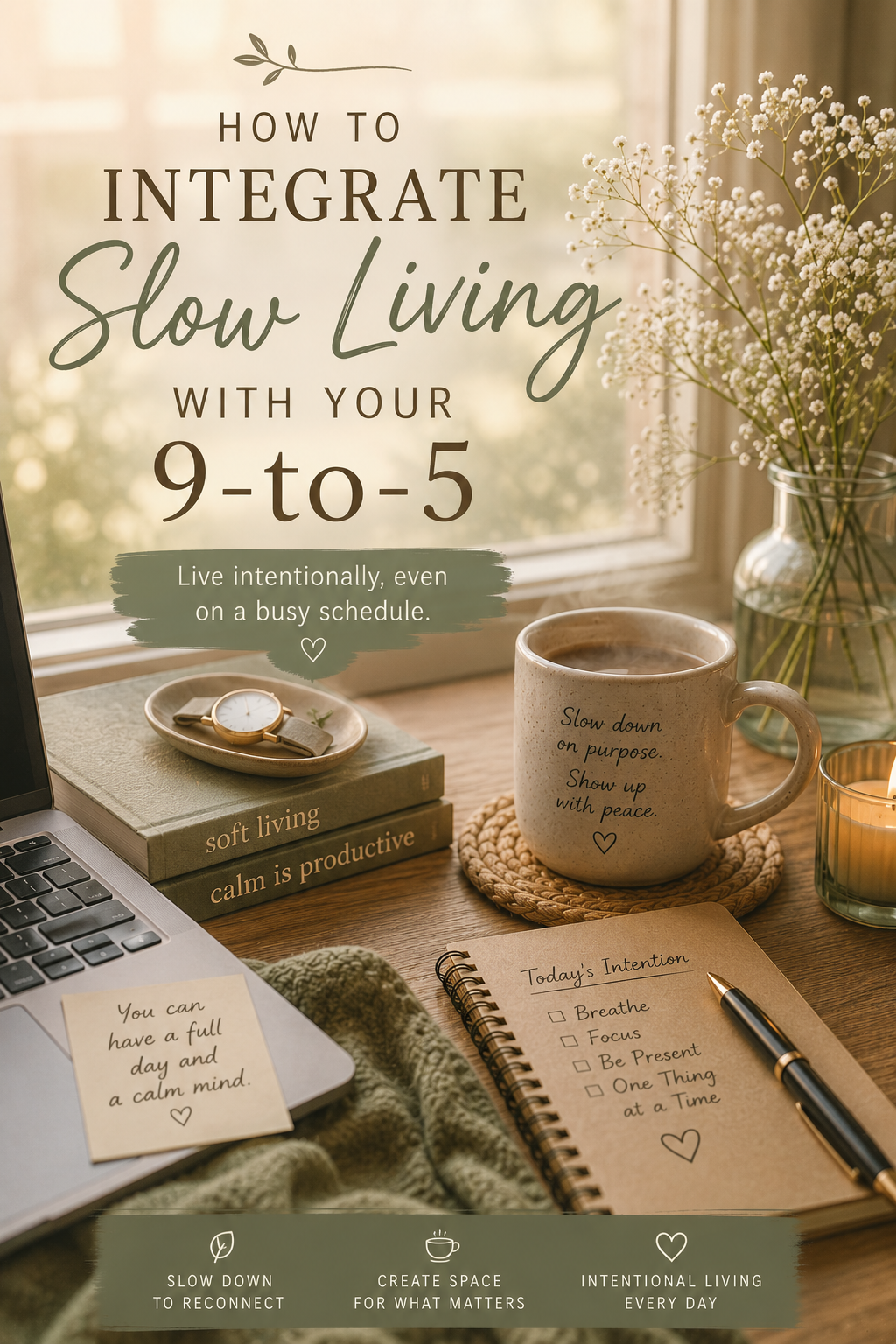
How to Integrate Slow Living With Your 9-to-5
Mindfulness by coffee

How to Integrate Slow Living With Your 9-to-5

Welcome to another Cupside Conversation. Pull up a chair. Maybe take a small sip of whatever is in your mug right now. Is it warm? Let that warmth ground you for a second. Today, we are talking about the space between the clock-in and the clock-out. The 9-to-5. For many of us, it feels like a place where "slow" goes to die. A place where the "hustle" is the only language spoken. But what if it didn’t have to be? What if you could carry your stillness into the office, the cubicle, or the home-office desk? Slow living is not a vacation. It is a way of being that you can invite into the busiest parts of your day. The Myth of Optimization We are often told to optimize. Optimize our morning routine. Optimize our workflow. Optimize our sleep so we can produce more tomorrow. It feels heavy, doesn't it? Like you are a machine that needs constant fine-tuning. At The Random Coffee Break, we invite you to choose recovery over optimization. Recovery is not just something you do when you are broken. It is a rhythm. It is the exhale after a long inhale. When you prioritize peace over pressure, you aren't doing "less." You are doing enough. And you are doing it with a soul that is still intact.

Small Moments of Stillness

You do not need an hour of meditation to find stillness at work. You only need a few seconds. Notice the weight of your feet on the floor while you wait for a file to download. Notice the texture of the keyboard under your fingers. Listen to the hum of the air conditioner. These are sensory anchors. They pull you out of the "fog" of a long to-do list and back into your body. Try a "micro-break." Not to check your phone, that is just more noise. But to look out the window. To watch the way the light hits the wall. To breathe. Three deep breaths can be a revolution in a crowded workday. Setting Gentle Boundaries Boundaries often feel like walls. Harsh and cold. But think of them instead as a garden fence. They protect the soft things growing inside. Slow living in a 9-to-5 requires a few gentle fences. Perhaps it is not checking your email before your first cup of coffee is finished. Perhaps it is leaving your desk for lunch. A real lunch. One where you taste your food. One where you are not "on." It is okay to say, "I am focusing on this right now; I will get back to you in an hour." It is okay to be unavailable for a moment. The world will wait for five minutes. We promise.

Shifting to a Soft Rhythm

Think of your workday as a piece of music. Hustle culture wants it to be a frantic drum beat. Loud. Constant. Exhausting. We invite you to find a softer rhythm. This means acknowledging that your energy ebbs and flows. Some hours are for deep focus. Some hours are for administrative tasks that require less of your heart. And some hours are for rest. When you stop fighting your natural energy levels, the friction begins to melt away. You are not "lazy" for needing a slower pace in the afternoon. You are human. And humans were never meant to be "on" for eight hours straight. Creating a Peaceful Environment Your physical space matters. It tells a story to your nervous system. If your desk is a mountain of old post-it notes and empty cups, your brain feels that clutter. Clear a small corner. Just one. Put a stone there, or a small plant, or a photo that makes you feel safe. Let your eyes rest on that spot when the "noise" of work gets too loud. Soft lighting can also change everything. If you can, turn off the harsh overhead lights. Use a small lamp. Let the shadows be soft. It is much harder to feel frantic when the room feels like a hug.

The End-of-Day Ritual

How do you leave work? Do you slam the laptop and immediately start worrying about dinner? Or do you close the day with intention? Try a "closing ceremony." Write down three things you accomplished, even if they were small. I sent that difficult email. I drank enough water. I took a deep breath during the meeting. Then, physically close your workspace. Put your pen away. Close the tabs. This signals to your brain that the "hustle" is over. You are entering the time for recovery. Consider This: A Quiet Practice If you find yourself feeling lost in the 9-to-5 fog, take a piece of paper. Don't worry about "doing it right." Just let the words unfold. What does "enough" look like for me today? Where did I feel a "pinch" of stress, and what was my body trying to tell me? What is one thing I can say "no" to tomorrow to create a pocket of peace? How does the light look in my workspace at 3:00 PM? If my workday had a scent, what would I want it to be? A Final Thought Integrating slow living into your work isn't about changing your job. It’s about changing how you inhabit it. It is a series of tiny, brave decisions to choose yourself over the output. You are more than your productivity. You are a person who deserves a quiet heart, even on a Tuesday afternoon.

Take what you need. Until the next quiet cup. -The Random Coffee Break

The Slow Rebuild: The Power of Gentle Reflection (Part 2)
Mindfulness by coffee

The Slow Rebuild: The Power of Gentle Reflection (Part 2)

There is a specific kind of silence that only arrives when the world is still waking up. It is a soft, blue-gray silence. The kind that doesn’t demand anything from you. In our first part of this series, we spoke about the initial pause. The moment you decide to stop running. But once you have stopped, what happens next? How do we begin to listen to the whispers that were drowned out by the noise? We call this phase the Slow Rebuild. It is not a construction site. There are no hard hats here. No deadlines. No blueprints that cannot be changed. Instead, it is a gentle rearranging of the furniture inside your soul. It is about finding where the light hits. And it begins with a single, tactile choice.

The Weight of the Page

We live in a world of glass and light. Our fingers tap on screens that offer no resistance. There is a speed to digital life that bypasses the heart. When you type, your thoughts can move as fast as a spark. But when your thoughts move that fast, they often don't have time to settle. They stay on the surface. This is why we invite you back to the ritual of the analog. There is a profound medicine in the physical weight of a journal. The way it sits on your lap, solid and expectant.

When you open our The Spirituality Journal you are not just opening a book. You are opening a door. Notice the texture of the paper beneath your fingertips. It is slightly toothy. It has a grain. It is waiting for you to leave a mark that cannot be erased with a thumb-press. There is something revolutionary about a mark that stays.

The Scratch of the Pen

Have you ever truly listened to the sound of a pen moving across paper? It is a rhythmic, grounding sound. A tiny, dry friction. It is the sound of a thought becoming a physical thing. In the digital world, your words are pixels. They are made of light. But in your journal, your words are made of ink and pressure. They have a scent. They have a shadow. When you write by hand, your brain is forced to slow down to the speed of your wrist. You cannot outrun yourself when you are holding a pen. You have to wait for the letters to form. You have to watch the ink dry. This delay is where the magic happens. In that micro-second of waiting, you find clarity. You notice the way your hand trembles when you write something difficult. You notice the way your handwriting rounds out and softens when you feel at peace.

The Nonna-Maxxing Revolution

Lately, we have been thinking a lot about what people are calling the "Nonna-Maxxing Revolution." It is a playful term for a very deep longing. It is the desire to live like our grandmothers did. To bake the bread. To mend the clothes. To sit by the window and simply watch the rain. It is a rejection of the "hustle" in favor of the "hum." The hum of the kettle. The hum of a quiet house. On The Random Coffee Break TV YouTube channel, you can also find relaxing ambient soundscapes and gentle ASMR. Rain against the window. A crackling fire. Quiet audio made especially for journaling and meditation. It is a soft companion for the moments when you want to return to a gentler, more human pace. Our ancestors weren't "behind the times." They were simply in sync with a human pace. They didn't have notifications to tell them they were falling behind. They had the seasons. They had the rising sun. When we embrace analog habits, we are nonna-maxxing our mental health. We are choosing the slow way because the slow way is the only way the soul can keep up.

Reflections for the Quiet Moments

If you are feeling the "fog" today, don't fight it. The fog is just a sign that you need to find your center. Find a wooden surface. A kitchen table. A desk by a window. A park bench. Open your journal and let your pen rest on the page for a moment. Don't feel the need to perform. Don't feel the need to be "profound." Just notice. Here are a few quiet invitations for your next session: What does the air feel like against your skin right now? If your current energy was a color, what shade would it be? What is one thing your body is trying to tell you that you’ve been too busy to hear? What would happen if you did "less" today? Notice how your body reacts to that last question. Does your chest tighten? Does your breath catch? That is the "hustle" trying to protect its territory. Breathe into that space. Tell that part of you that it’s okay to rest.

The Softened Rhythm

We often think that to "rebuild," we need to be strong. We think of steel and stone. But a slow rebuild is more like a garden. It requires softness. It requires the ability to bend without breaking. It requires the patience to watch things grow at their own speed.

When you sit with your coffee and your journal, you are gardening your inner world. You are pulling the weeds of "should" and "must." You are planting the seeds of "I am" and "I feel." This is not a quick fix. It is a sustainable practice. It is a way of saying to yourself: "I am worth the time it takes to understand me."

A Look Ahead: The Quiet Exit

As we move through this rebuilding phase, we are preparing for something special. On May 3rd, we will be launched "The Quiet Exit." It is a new collection and a new philosophy. It is about how we leave the spaces that no longer serve us. How we walk away from the noise without slamming the door. How we exit the "always-on" culture with grace. You can read more about the heart behind this in our recent post: The Quiet Exit: A Gentle Rebuilding for Your Next Chapter. It is an invitation to choose a different path. A softer path.

The Invitation

Before you close this tab and return to the digital stream. Pause. Take a deep breath. Feel the floor beneath your feet. If you have a journal nearby, perhaps write down one word. Just one. How do you feel in this exact second? Not how you want to feel. Not how you think you should feel. But the truth of the moment. Carry that truth with you. It is the most honest thing you own.

The world can wait for five minutes. It really can. And in those five minutes, you might just find the piece of yourself you’ve been looking for.

Take what you need. Until the next quiet cup.

The Quiet Exit: A Gentle Rebuilding for Your Next Chapter
Mindfulness by coffee

The Quiet Exit: A Gentle Rebuilding for Your Next Chapter

You have been running for a long time. Perhaps you didn’t notice the pace at first. It started as a light jog. A series of deadlines. A few extra notifications. The hum of the office. The chime of the email. And then, slowly, the world became very loud. You are not broken. You are simply full. You are full of voices that are not your own. Full of expectations that don't fit the shape of your soul. Full of a "hustle" that has left you hollow. Maybe you are sitting at your desk right now. Your eyes are heavy. The screen is a blur of blue light and demands. You feel a tug. A quiet pull toward the door. Toward the window. Toward a life that feels like yours again. This is the beginning of your quiet exit.

The Fog of the Constant Connection

Burnout is not a wall. It is a fog. It settles in the corners of your room. It sits in the bottom of your coffee cup. It makes the simplest tasks feel like walking through deep water. You might feel like you are losing your grip on the things you once loved. You might feel like you are losing yourself. We want you to know: It is okay to be tired. It is okay to want out.

The "Quiet Exit" is not about a dramatic resignation. It is not about burning bridges. It is about a soft withdrawal from the noise. It is an invitation to stop giving your energy to things that do not give it back. Notice how your body feels when you think about "doing less." Does your chest tighten? Or does it finally, for a moment, soften? Listen to that softness. An Invitation to Stillness

At The Random Coffee Break, we believe in the power of the pause. We believe that a warm mug held in two hands is a sacred thing. The steam rising. The warmth seeping into your palms. The world slowing down to the speed of a sip. This is where the rebuilding begins. Not in the grand plans for a new career. Not in the five-year strategy. But in the stillness of this morning. Stillness is not laziness. Stillness is the soil where clarity grows. When you sit still, the silt in the water of your mind begins to settle. The clouds begin to part. And eventually, life starts to come back into focus. You do not need to have the answers today. You only need to have the breath. Inhale. Notice the cool air. Exhale. Notice the release. The world can wait for five minutes. Truly. It can. The emails will stay in the inbox. The projects will remain on the list. The expectations of others will linger. But for these five minutes, you belong to yourself. Introducing: The Calming Journal

We made something gentle for you. For the dreamers who are tired. For the achievers who are empty. For the creatives who have lost their spark. The Calming Journal is now live. It is available now in our website (www.TheRandomCoffeeBreak.com) and on Gumroad. This is not a "productivity" workbook. It will not tell you how to "optimize" your exit. It will not give you a checklist for a six-figure pivot. Instead, it is a collection of quiet practices. A series of reflective prompts. A map for returning to your own center. It is built upon our three pillars: Stillness: Learning to sit with the silence until it feels like a friend. Reflection: Identifying the "noise" that has been masquerading as your own voice. Rebuilding: Creating intentional habits that honor your energy, not just your output. This workbook is designed for the moments between. The moments when you are transitioning from the corporate world. The moments when you are closing one chapter and haven't yet opened the next. It is a soft place to land. Softness with Structure

We know that "slowing down" can feel terrifying. When you have been defined by your "doing," "being" feels like a risk. You might fear that if you stop, you will never start again. You might fear that you will be forgotten. The Quiet Exit is about building a structure of softness. It is about morning rituals that ground you. It is about evening reflections that clear the day. It is about listening to the parts of yourself that have been whispered away. In the workbook, you will find: Quiet prompts for morning light. Gentle movement invitations for tired bodies. Space to mourn what you are leaving behind. Guided stillness for when the anxiety rises. We want to help you rebuild. But we want you to rebuild slowly. Brick by brick. Breath by breath. There is no rush to the finish line. The finish line is an illusion anyway.

Your First Quiet Practice

You do not have to wait to begin. You can begin right now. Set down your phone. Close your eyes. Or soften your gaze on something neutral. Notice the weight of your body in the chair. The way the floor supports your feet.

Ask yourself: What is one thing I am carrying that is not mine? Maybe it is a boss's frustration. Maybe it is a parent's expectation. Maybe it is a society's definition of success. Imagine yourself setting it down. Just for a moment. Like a heavy bag at the end of a long walk. You don't have to throw it away yet. Just notice how it feels to let your shoulders drop. This is the work. This is the rebuilding.

A Note on the Journey Ahead We are so glad you are here. The world needs more people who have dared to slow down. More people who have chosen softness over the grind. More people who have taken a quiet exit. You are part of a community that understands. A community that knows that taking a break isn't lazy. It is revolutionary self-care.

If you have been waiting for a softer way to begin again, this is your invitation. You can meet this next chapter with a little hope. A little steadiness. A little more room to breathe. Your next chapter is unfolding. And it is allowed to be gentle. The world can wait for five minutes. But your soul has waited long enough.

Softly, The Random Coffee Break Team

The Random Coffee Break is a space built on life experience and the shared journey of finding calm in a loud world. Please be advised that we are not medical or mental health professionals. The content shared here—including our journals, blog posts, and guides—is for personal reflection and informational purposes only.

If you are experiencing distress or require professional help, please seek the proper medical or therapeutic attention immediately. Your well-being is sacred; please treat it with the professional care it deserves.