The Random Coffee Break
slow moments • gentle clarity • quiet courage

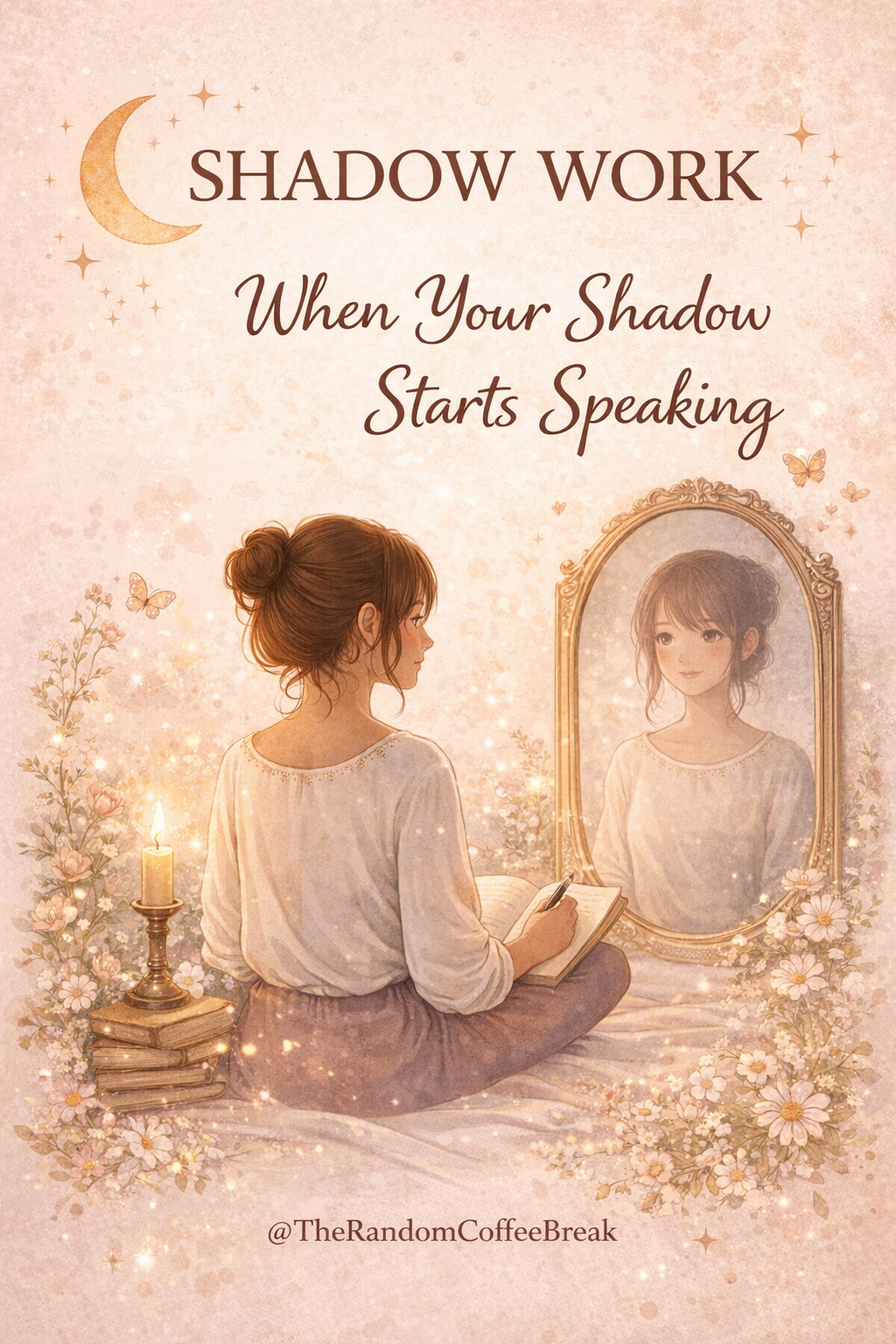
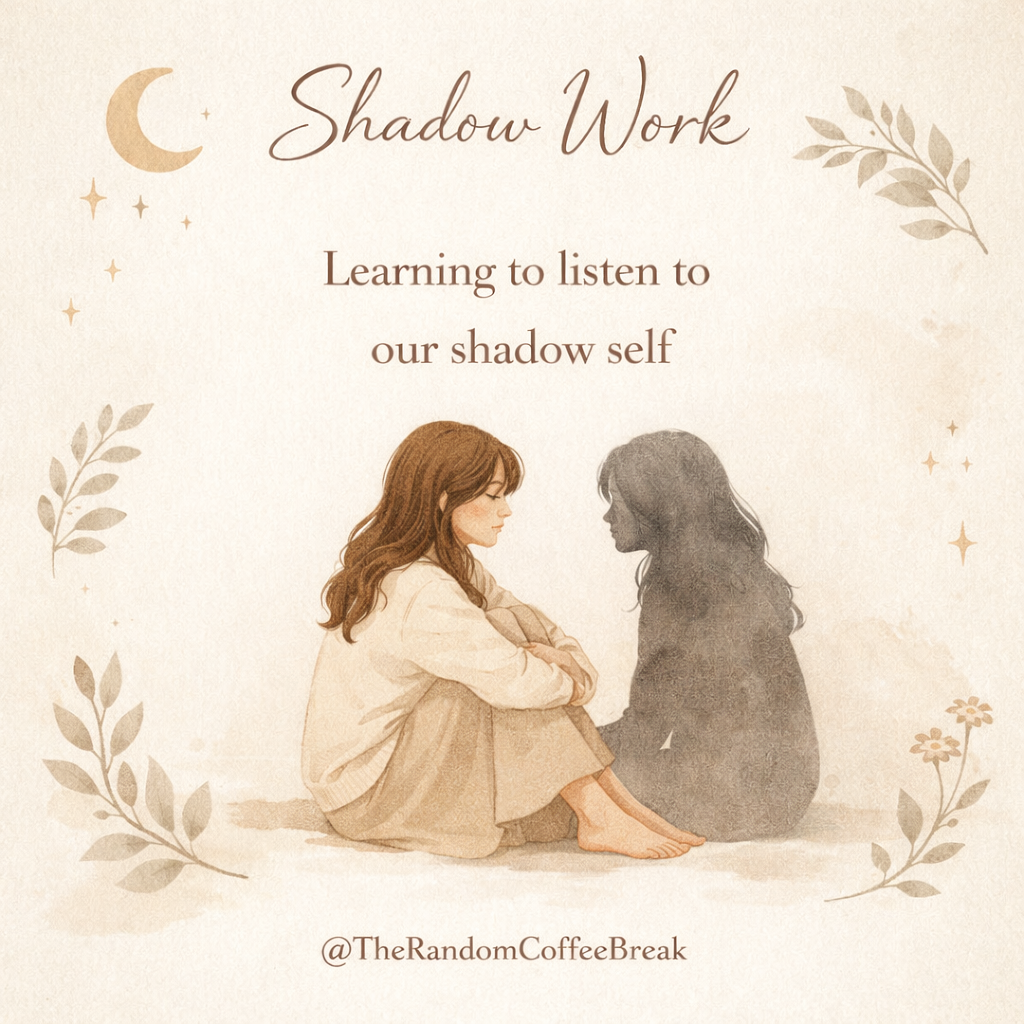
There are parts of us we learn to hide. Not because they are bad. Not because they are broken. But because somewhere along the way, the world suggested they were too much.

Too emotional. Too sensitive. Too angry. Too needy. Too quiet. Too different.

So we tuck those pieces away like old letters in the back of a drawer — hoping that if we do not look at them, they will simply disappear. But they do not disappear.

They wait. This is where shadow work begins. Not as punishment. Not as self-criticism. But as a gentle invitation to turn the light back on.

What Shadow Work Really Means

In psychology, the “shadow” refers to the parts of ourselves we learned to suppress — often in childhood or during painful life experiences. These parts might include: • anger we were told was unacceptable • needs that were ignored • boundaries we were never allowed to have • grief that was never processed • dreams we were discouraged from pursuing

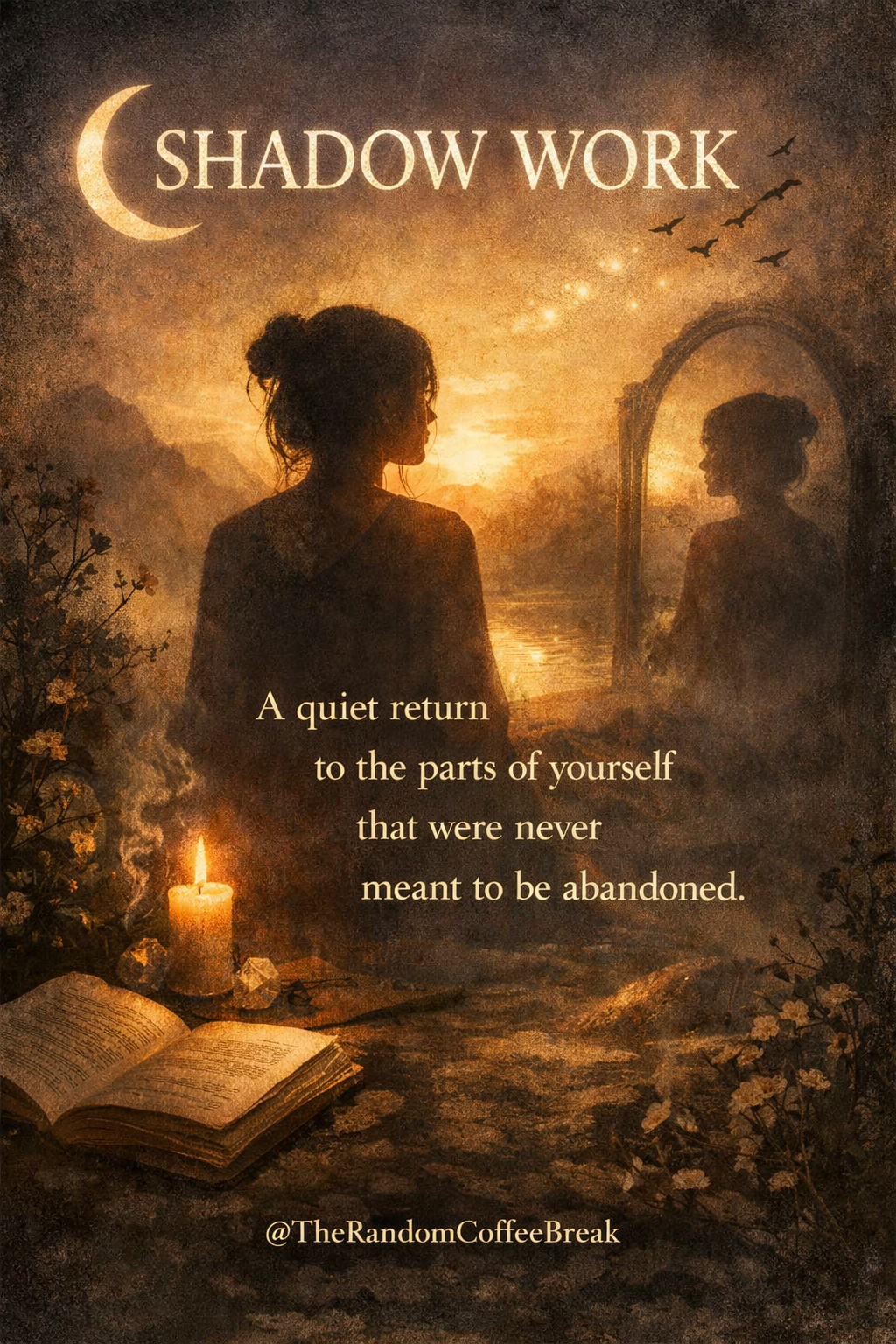
Shadow work is the process of meeting these hidden parts with curiosity instead of judgment. It is not about fixing yourself. It is about remembering yourself. Often, what lives in the shadow is not darkness at all — but pieces of your original self that were simply forced into hiding.

Why the Shadow Feels So Uncomfortable

Many people avoid shadow work because it can feel unsettling at first. Looking inward can reveal emotions we have spent years trying to outgrow, outrun, or outwork. But those emotions are not enemies. They are unfinished conversations within us. Anger might be the voice of a boundary that was crossed. Jealousy might reveal a dream you abandoned. Fear might point to a place where you once felt powerless. The shadow does not appear to shame you. It appears to be witnessed. And strangely, once it is acknowledged, its grip often softens.

**

The Gentle Way to Begin

** Shadow work does not have to be dramatic or overwhelming. It can begin quietly — often with something as simple as a journal and a few honest questions.

You might start by asking yourself: • What emotions do I judge most harshly in myself? • When do I feel triggered or defensive? • What traits in others bother me deeply? • What part of myself do I try hardest to hide? These questions are not accusations. They are doorways. And behind each doorway is a deeper understanding of who you are.

**

Compassion Is the Real Work

** One of the biggest misconceptions about shadow work is that it is about confronting darkness. In reality, it is about offering compassion to the parts of you that never received it. The child who felt unheard. The version of you who stayed too long. The person who carried more responsibility than they should have. Shadow work is not about digging endlessly into pain.

It is about saying: "I see you now. You don't have to hide anymore." And often, the moment you do that, healing begins.

**

A Quiet Truth

** The parts of you living in the shadow are not enemies of your growth. They are protectors who never learned they could rest. When you listen to them with patience instead of resistance, they slowly begin to trust you again. And the energy it once took to keep those parts hidden becomes available for something new. Clarity. Peace. Self-trust.

**

A Gentle Reminder

** You do not have to rush this process. Shadow work is not a race toward perfection. It is a slow unfolding of honesty, curiosity, and compassion. Some days it may look like deep reflection. Other days it may simply look like noticing a feeling without pushing it away. Both are progress. Both are healing.

**

A Quiet Coffee Break Reflection

** Tonight, or tomorrow morning with your coffee, you might ask yourself one small question: What part of me has been waiting to be understood? You do not need to solve it all at once. Just listen. Sometimes the most powerful healing begins the moment we stop abandoning ourselves.

☕ Take what you need. Until the next quiet cup, The Random Coffee Break

There are parts of us that quietly shape our lives. Not the parts we show easily. Not the strengths we celebrate. But the parts we learned to hide. The emotions we pushed aside. The needs we were told were too much. The truths we didn’t feel safe enough to speak. In the world of personal growth, these hidden pieces are often called the shadow.

But shadow work is not about searching for darkness inside yourself. It is about gently turning the light back on. Over the next few posts on The Random Coffee Break, we will explore a quiet journey inward — one that many people sense they need but rarely know how to begin.

Not in a dramatic or overwhelming way. Just slowly. Honestly. With the same patience you might bring to a long conversation with a trusted friend.

Here is the path we’ll walk together: ☕ Shadow Work Understanding the hidden parts of ourselves that influence our reactions, relationships, and inner world.

☕ When Your Shadow Starts Speaking Recognizing the moments when buried emotions or patterns begin asking for attention.

☕ Making Peace With Your Shadow Learning how compassion — not criticism — helps integrate the parts of ourselves we once rejected. ☕ The Gifts Hidden in Your Shadow Discovering how the traits we once suppressed often carry the seeds of our greatest strengths.

☕ When the Old Version of You Starts to Fall Away Navigating the strange and sometimes emotional transition when growth begins to reshape our identity.

☕ The Quiet Confidence That Comes After Shadow Work The calm, grounded self-trust that slowly grows when we stop abandoning ourselves.

This series is not about fixing who you are. It is about understanding yourself more deeply. And sometimes, the simple act of understanding is what begins the healing. If you’ve ever felt like parts of your story were left unexplored… or like certain emotions still linger beneath the surface… this may be a gentle place to begin.

No pressure. No expectations.

Just a quiet invitation to look inward with curiosity instead of judgment. If any of these reflections resonate with you, I invite you to visit the blog this week and read along.

And if you feel comfortable, you might even bring a journal with you. Sometimes the most meaningful discoveries happen in the quiet spaces between our thoughts.

Until the next quiet cup, The Random Coffee Break

Vision

- Posted in Self-Awareness by

Create Your Own Vision

Learning to See the Life That Is Waiting for You

Once clarity returns, something interesting begins to happen. Your life no longer feels quite as foggy. The noise settles. Your thoughts soften. And slowly, a new question begins forming: If I can see my life more clearly now… what do I want to build from here? This is where vision begins. Not the kind that comes from pressure or expectations. But the quiet vision that emerges when you reconnect with yourself.

Vision Is Not a Perfect Plan

Many people believe vision requires a fully mapped future. A five-year plan. Clear milestones. Complete certainty. But real vision rarely arrives that way. More often, it begins as a feeling. A gentle pull toward something different. A desire for a slower life. A longing for meaningful work. A quiet dream that refuses to disappear. Vision is less about control and more about direction. It simply helps you see where your life wants to move.

Vision Grows From Self-Awareness

Without clarity, vision becomes difficult. We begin chasing goals that were never truly ours. We pursue achievements that impress others but leave us feeling empty. But when you understand yourself more deeply, your vision changes. You begin asking different questions: What kind of life feels peaceful to me? What kind of work feels meaningful? What kind of pace allows me to stay healthy and present? Your vision begins aligning with your values instead of external pressure.

Small Visions Change Lives

Vision does not need to be dramatic to be powerful. Sometimes vision simply looks like this: Wanting more quiet mornings. Protecting your emotional energy. Creating space for creativity. Building a life that feels slower and more intentional. Small visions are often the most sustainable. They shape the way we live each day.

Vision Is Allowed to Evolve

One of the most freeing realizations in personal growth is this: Your vision is allowed to change. The person you were five years ago needed different things than the person you are today. Growth brings new understanding. Your dreams may soften. Your priorities may shift. Your definition of success may become more personal. This is not failure. It is maturity. Vision should grow with you.

The Courage to Follow What You See

Seeing the life you want is one thing. Allowing yourself to move toward it is another. Vision often asks us to release things that no longer fit. Old expectations. Overcommitment. The pressure to live according to someone else's timeline. This requires courage. But it also creates freedom. Every small step toward your vision strengthens your sense of alignment.

A Quiet Practice for Discovering Your Vision

If you are unsure what direction your life is moving toward, try this reflection. Find a quiet place. Imagine your life one year from now — not the version others expect, but the version that feels peaceful and meaningful to you. Then journal these questions: • What does a calm and fulfilling day look like? • What kind of work or creativity fills that day? • What boundaries protect your peace? • What values guide your decisions? Your vision may not appear all at once. But pieces will begin forming. And those pieces will guide your next steps.

A Final Thought

You do not need to see the entire path ahead. Vision is simply the ability to recognize the direction that feels true. Clarity helps you see where you are. Vision helps you see where your life wants to grow. And both begin the same way — in quiet moments where you choose to listen to yourself again.


☕ *****Journal Prompt***** If your life felt peaceful and aligned one year from now, what would your days look like? Write without editing yourself. Your vision often appears in the details.


Take what you need. Until the next quiet cup, The Random Coffee Break

Clairty

- Posted in Healing by

When Your Life Finally Comes Back into Focus

There are seasons in life when everything feels slightly out of focus. You are moving through your days, fulfilling responsibilities, answering messages, meeting expectations — yet something inside you feels distant. Not broken, just… blurred. Your thoughts feel crowded. Your energy feels scattered. And the life you once imagined feels harder to see clearly. This is what happens when we move through life for too long without pause. Clarity is not something we lose overnight. It fades slowly when our attention is constantly pulled outward. But the good news is this: Clarity returns the same fashion as it disappears — gently.

The Fog That Builds Quietly

Most people do not notice when their inner clarity begins fading. It happens in small ways. You start saying yes to things that drain you. You ignore the quiet signals your body sends. You begin living according to urgency rather than intention. Eventually, everything starts to feel heavier than it should. Not because your life is wrong — but because your inner compass has become difficult to hear. Clarity is simply the moment that compass becomes audible again.

Clarity Begins With Slowing Down

The world often encourages us to respond to confusion with more effort. Work harder. Think harder. Push harder. But clarity rarely comes from pressure. It comes from space. Space to breathe. Space to think. Space to listen.

In the quiet aesthetic of The Random Coffee Break, clarity often begins with small rituals of stillness:

A journal opened in the morning light. A walk without headphones. Five minutes of silence before the day begins. These are not small habits. They are moments where your inner voice can finally speak again.

Writing Your Way Back to Yourself

One of the simplest ways to rediscover clarity is through journaling. When thoughts stay inside the mind, they often spin endlessly. But when you place them on paper, something shifts. Thoughts begin organizing themselves. Patterns begin emerging. Truth becomes easier to recognize. Your journal does not need to be perfect. It only needs to be honest. Sometimes clarity arrives halfway through a sentence you almost did not write.

Clarity Does Not Mean Having Every Answer

Many people avoid reflection because they believe clarity requires immediate solutions. But clarity is not about solving your entire life. It is about seeing things truthfully. You might realize: • You are carrying too much responsibility • A relationship no longer feels aligned • Your life needs more rest than productivity • A creative part of you has been waiting to return These realizations are not problems. They are information. Clarity is simply awareness — and awareness is where change begins.

A Quiet Practice for Finding Clarity

If your thoughts feel crowded, try this simple reflection. Find a quiet space. Pour yourself something warm. Open your journal. Then write slowly through these questions: • What currently feels heavy in my life? • What feels peaceful or aligned? • Where might I be ignoring my own needs? • What would bring more calm into my days? Do not rush. Clarity unfolds slowly — like morning light entering a room.

A Final Thought

You do not need to rush your life into focus. Clarity is not something we force. It is something that returns when we make space for truth. Sometimes all it takes is a quiet moment, an open journal, and the willingness to listen to yourself again.


Journal Prompt Where in your life do you feel the most clarity right now — and where do you feel the most fog?

Write gently. Your answers do not need to be perfect to be honest.

Take what you need. Until the next quiet cup, The Random Coffee Break

Sunday Evening Pause

Finding Clarity and Rediscovering Vision

Hello Coffee Friends, Sunday evenings have a quiet kind of honesty to them. The week behind us begins to settle. The week ahead hasn’t quite begun yet. For a brief moment, life sits in a soft space between reflection and possibility. It’s often during these slower moments that we start asking ourselves deeper questions. Where am I going? Why do some parts of life feel so heavy? What would a more peaceful life actually look like? These questions are not signs that something is wrong. They are usually signs that your inner compass is trying to speak again. This week at The Random Coffee Break, we are exploring two ideas that often appear together when life begins to slow down enough for reflection: clarity and vision. Not the loud, productivity-driven versions the world tends to promote. But the quiet kind that grows when we pause long enough to hear ourselves again.


A New Post This Week Includes:

☕ Clarity: When Your Life Comes Back Into Focus Sometimes life does not fall apart. It simply becomes blurry. We move through responsibilities, expectations, and routines until our own voice becomes difficult to hear. Clarity is not about solving everything at once. It is about slowly bringing your life back into focus so you can recognize what truly belongs in it. In this post we explore: • Why clarity fades when life becomes overwhelming • How slowing down helps your inner compass return • A gentle journaling practice to help you reconnect with yourself If your mind has felt crowded or your direction uncertain lately, this piece may feel like a deep breath.


Later This Week

☕ Vision: Learning to See the Life Waiting for You Once clarity returns, something beautiful begins to happen.

Your life no longer feels quite as foggy. And in that quiet space, a new question begins forming: If I can see my life more clearly now… what do I want to build from here? Vision is not about creating pressure or perfect plans. It is about recognizing the life that feels aligned with who you are becoming. This second post explores: • Why vision grows from self-awareness • How small visions can reshape an entire life • A reflective exercise for discovering the direction that feels true for you Sometimes vision arrives softly — like morning light slowly filling a room.


A Quiet Invitation

Tonight, before the new week begins, you might try something simple. Pour a warm drink. Open a journal. Let the room grow quiet for a few minutes. Then gently ask yourself: Where in my life do I feel clarity right now? And where might my life be asking for a new vision? You do not need to solve anything tonight. Sometimes the most important thing we can do is simply listen. Clarity and vision tend to follow.


Journal Prompt for the Week If my life felt calmer and more aligned one year from now, what would my days look like?

Write slowly. The answers often appear between the sentences.


Take what you need. Until the next quiet cup, The Random Coffee Break

Somatic Healing

- Posted in Healing by

Somatic Healing

When the Body Finally Gets to Speak

There are seasons when your mind understands everything… and your body still feels tight. You’ve journaled. You’ve processed. You’ve talked it through. And yet — your shoulders stay lifted. Your jaw stays clenched. Your nervous system hums like it forgot how to power down. This is where somatic healing begins. Not in the thinking. In the feeling.

What Is Somatic Healing?

Somatic healing is the practice of listening to the body as an active participant in your emotional life. The word somatic comes from the Greek word soma, meaning “body.” It’s rooted in the understanding that trauma, stress, and chronic emotional strain are not just stored in thoughts — they are stored in tissues, posture, breath, and nervous system patterns. Your body remembers what your mind tries to minimize. It remembers the over giving. The hypervigilance. The years you stayed strong when you were actually overwhelmed. Somatic work gently asks: Where is this living in you?

The Body Keeps Score (But It Also Keeps Wisdom)

Have you ever noticed: • Anxiety sitting in your chest? • A knot in your stomach before difficult conversations? • Exhaustion that feels cellular, not just mental? • Shoulders that never quite drop? Your nervous system is not dramatic. It is protective. When you’ve lived in survival mode — even subtly — your body adapts. Muscles tighten. Breath shortens. The sympathetic nervous system (fight or flight) becomes the default setting. And over time, that becomes your “normal.” Somatic healing helps you come home to regulation.

Why Talking Isn’t Always Enough

Cognitive insight is powerful. Understanding your patterns matters. But trauma and chronic stress are often pre-verbal. They live beneath language.

You can know: • “I am safe now.” • “I don’t have to overperform.” • “I don’t have to carry everything.” And still feel braced. Because safety is not a thought. It is a sensation. Somatic healing focuses on helping the body experience safety again — not just understand it intellectually.

Gentle Somatic Practices You Can Begin Today

Nothing dramatic. Nothing overwhelming. Just small invitations.

1. The 60-Second Shoulder Drop Right now, notice your shoulders. Let them fall. Exhale slowly through your mouth. Do it again. This tells your nervous system: You are not in danger.

2. Hand on Heart, Hand on Stomach Place one hand on your chest and one on your abdomen. Breathe in slowly for four counts. Exhale for six. Longer exhales activate the parasympathetic nervous system — your body’s “rest and digest” state. Whisper (literally or internally): “I am here. I am safe in this moment.”

3. Orienting to the Room Look around slowly. Name five neutral or pleasant things you see: • The light on the wall. • The steam from your mug. • The texture of your journal. • The plant in the corner. • The quiet. This anchors you in the present. Trauma pulls us backward. Anxiety pulls us forward. Somatic awareness brings us here.

4. Micro-Movements Gently roll your neck. Unclench your jaw. Stretch your fingers wide. Press your feet into the floor. Small movements releases tension that talk therapy alone cannot access.

Somatic Healing for the Over-givers

Somatic healing is especially powerful for those who: • Learned to be strong early. • Feel responsible for other people’s emotional stability. • Live in quiet hypervigilance. • Feel emotionally stagnant but physically exhausted. • Fear that everything they’ve built could collapse. The body of an over-giver is often braced. Healing is not about doing more. It’s about softening.

What Somatic Healing Is Not It is not bypassing therapy. It is not ignoring thoughts. It is not dramatic emotional release on command. It is slow. It is subtle. It is learning the difference between tension and safety. Between bracing and resting. Between surviving and settling.

The Random Coffee Break Way: Slow, Safe, Gentle At The Random Coffee Break, we don’t force transformation. We sip it. Somatic healing fits beautifully into this slow-living ethos. It is journaling after you breathe. It is writing once your shoulders drop. It is letting your body exhale before you analyze. You do not have to rush into who you are becoming. Your nervous system has been carrying you for years. Let it learn something new: You are allowed to rest.

A Journal Prompt for Tonight Before you close your day, write: • Where do I hold tension most often? • What does my body feel like when I am safe? • When was the last time my shoulders truly dropped? • What would “soft” feel like in my body? Let your answers be sensory, not intellectual. Warm. Heavy. Loose. Grounded. Open.

Somatic healing is not about fixing yourself. It is about befriending the body that protected you. And teaching it — gently — that the storm has passed. Sit with your breath tonight. Feel your feet on the floor. Let your body know it no longer has to guard every door. Take what you need. Until the next quiet cup.

Disclaimer: The content provided by The Random Coffee Break is for informational and educational purposes only and is not medical or mental health advice. It is not a substitute for professional care. Please consult a qualified healthcare or mental health provider regarding your specific situation.

When Healing Moves Through the Body

- Posted in Healing by

When Healing Moves Through the Body

Hello, gentle soul —

Tonight, I want to talk about a kind of healing that doesn’t always show up in words. Not the kind you announce. Not the kind you post about. Not even the kind you fully understand yet. I’m talking about emotional healing — the quiet, internal kind. The kind that lives in your shoulders, in your breath, in the way your jaw tightens when you’re trying to hold it all together. Sometimes we think healing is a mindset shift. But often… it is a nervous system shift.

Emotional Healing Is Not Just Mental

You can intellectually understand your trauma and still feel it in your body. You can forgive someone and still feel your stomach clench when their name appears. You can “move on” and still feel your chest tighten when something reminds you. This is where somatic healing enters.

Somatic healing gently teaches us that the body keeps score — not to punish us, but to protect us. The body remembers what the mind tried to survive.

And here is the beautiful part:

The body can also learn safety. Not through force. Not through pressure. But through presence.

What Somatic Healing Actually Looks Like

It doesn’t always look dramatic.

Sometimes it looks like: • Noticing your breath instead of judging it. • Letting your shoulders drop an inch. • Placing a hand on your chest and staying there. • Rocking gently. • Taking a slower sip of coffee.

Sometimes healing is simply teaching your body:

“You are not there anymore.” Safety is not only a thought. It is a felt experience. And it can be practiced.

Where Journaling Comes In

Journaling is the bridge. It is where emotion meets language. When we write, we slow down the storm. We move feelings from the body into expression. We give shape to what felt overwhelming.

But here’s the deeper truth: Journaling is not about solving. It is about witnessing. Instead of asking, “How do I fix this?” Try asking, “What is my body trying to tell me?”

You might write: • “My chest feels tight today.” • “I notice I am bracing.” • “I am tired of being strong.” • “I don’t feel safe when…” And instead of correcting yourself — you stay. That staying is healing.

A Gentle Practice for This Week

The next time emotion rises: 1. Pause. 2. Place one hand on your body. 3. Ask softly, “What do you need right now?” 4. Write the answer without editing it.

No performance. No perfection. Just honesty. Healing is not loud. It is the quiet decision to stay with yourself when running would be easier.

Should you choose there is a somatic healing PDF book called, “The Grounded Cup” that can be found on the ETSY store @ https://mindessentialdesigns.etsy.com/ Also, for relaxing listening while you are journaling try: youtube.com/@GoodBearVibes

If You Needed Permission

You do not have to force growth. Your nervous system blooms best in safety, not in pressure. Your protectors are not your enemies. They are tired parts of you asking to be understood. And internal healing begins the moment you say, “I am willing to understand myself without judgment.”

Tonight, let your body soften a little. Let your breath deepen by one inch. Let the page hold what you no longer want to carry alone. Take what you need. Until the next quiet cup.

— Bridget The Random Coffee Break

Disclaimer: The content provided by The Random Coffee Break is for informational and educational purposes only and is not medical or mental health advice. It is not a substitute for professional care. Please consult a qualified healthcare or mental health provider regarding your specific situation.

The Random Coffee Break is a space built on life experience and the shared journey of finding calm in a loud world. Please be advised that we are not medical or mental health professionals. The content shared here—including our journals, blog posts, and guides—is for personal reflection and informational purposes only.

If you are experiencing distress or require professional help, please seek the proper medical or therapeutic attention immediately. Your well-being is sacred; please treat it with the professional care it deserves.