The Random Coffee Break
slow moments • gentle clarity • quiet courage

Sunday Evening Pause

Finding Clarity and Rediscovering Vision

Hello Coffee Friends, Sunday evenings have a quiet kind of honesty to them. The week behind us begins to settle. The week ahead hasn’t quite begun yet. For a brief moment, life sits in a soft space between reflection and possibility. It’s often during these slower moments that we start asking ourselves deeper questions. Where am I going? Why do some parts of life feel so heavy? What would a more peaceful life actually look like? These questions are not signs that something is wrong. They are usually signs that your inner compass is trying to speak again. This week at The Random Coffee Break, we are exploring two ideas that often appear together when life begins to slow down enough for reflection: clarity and vision. Not the loud, productivity-driven versions the world tends to promote. But the quiet kind that grows when we pause long enough to hear ourselves again.


A New Post This Week Includes:

☕ Clarity: When Your Life Comes Back Into Focus Sometimes life does not fall apart. It simply becomes blurry. We move through responsibilities, expectations, and routines until our own voice becomes difficult to hear. Clarity is not about solving everything at once. It is about slowly bringing your life back into focus so you can recognize what truly belongs in it. In this post we explore: • Why clarity fades when life becomes overwhelming • How slowing down helps your inner compass return • A gentle journaling practice to help you reconnect with yourself If your mind has felt crowded or your direction uncertain lately, this piece may feel like a deep breath.


Later This Week

☕ Vision: Learning to See the Life Waiting for You Once clarity returns, something beautiful begins to happen.

Your life no longer feels quite as foggy. And in that quiet space, a new question begins forming: If I can see my life more clearly now… what do I want to build from here? Vision is not about creating pressure or perfect plans. It is about recognizing the life that feels aligned with who you are becoming. This second post explores: • Why vision grows from self-awareness • How small visions can reshape an entire life • A reflective exercise for discovering the direction that feels true for you Sometimes vision arrives softly — like morning light slowly filling a room.


A Quiet Invitation

Tonight, before the new week begins, you might try something simple. Pour a warm drink. Open a journal. Let the room grow quiet for a few minutes. Then gently ask yourself: Where in my life do I feel clarity right now? And where might my life be asking for a new vision? You do not need to solve anything tonight. Sometimes the most important thing we can do is simply listen. Clarity and vision tend to follow.


Journal Prompt for the Week If my life felt calmer and more aligned one year from now, what would my days look like?

Write slowly. The answers often appear between the sentences.


Take what you need. Until the next quiet cup, The Random Coffee Break

Somatic Healing

- Posted in Healing by

Somatic Healing

When the Body Finally Gets to Speak

There are seasons when your mind understands everything… and your body still feels tight. You’ve journaled. You’ve processed. You’ve talked it through. And yet — your shoulders stay lifted. Your jaw stays clenched. Your nervous system hums like it forgot how to power down. This is where somatic healing begins. Not in the thinking. In the feeling.

What Is Somatic Healing?

Somatic healing is the practice of listening to the body as an active participant in your emotional life. The word somatic comes from the Greek word soma, meaning “body.” It’s rooted in the understanding that trauma, stress, and chronic emotional strain are not just stored in thoughts — they are stored in tissues, posture, breath, and nervous system patterns. Your body remembers what your mind tries to minimize. It remembers the over giving. The hypervigilance. The years you stayed strong when you were actually overwhelmed. Somatic work gently asks: Where is this living in you?

The Body Keeps Score (But It Also Keeps Wisdom)

Have you ever noticed: • Anxiety sitting in your chest? • A knot in your stomach before difficult conversations? • Exhaustion that feels cellular, not just mental? • Shoulders that never quite drop? Your nervous system is not dramatic. It is protective. When you’ve lived in survival mode — even subtly — your body adapts. Muscles tighten. Breath shortens. The sympathetic nervous system (fight or flight) becomes the default setting. And over time, that becomes your “normal.” Somatic healing helps you come home to regulation.

Why Talking Isn’t Always Enough

Cognitive insight is powerful. Understanding your patterns matters. But trauma and chronic stress are often pre-verbal. They live beneath language.

You can know: • “I am safe now.” • “I don’t have to overperform.” • “I don’t have to carry everything.” And still feel braced. Because safety is not a thought. It is a sensation. Somatic healing focuses on helping the body experience safety again — not just understand it intellectually.

Gentle Somatic Practices You Can Begin Today

Nothing dramatic. Nothing overwhelming. Just small invitations.

1. The 60-Second Shoulder Drop Right now, notice your shoulders. Let them fall. Exhale slowly through your mouth. Do it again. This tells your nervous system: You are not in danger.

2. Hand on Heart, Hand on Stomach Place one hand on your chest and one on your abdomen. Breathe in slowly for four counts. Exhale for six. Longer exhales activate the parasympathetic nervous system — your body’s “rest and digest” state. Whisper (literally or internally): “I am here. I am safe in this moment.”

3. Orienting to the Room Look around slowly. Name five neutral or pleasant things you see: • The light on the wall. • The steam from your mug. • The texture of your journal. • The plant in the corner. • The quiet. This anchors you in the present. Trauma pulls us backward. Anxiety pulls us forward. Somatic awareness brings us here.

4. Micro-Movements Gently roll your neck. Unclench your jaw. Stretch your fingers wide. Press your feet into the floor. Small movements releases tension that talk therapy alone cannot access.

Somatic Healing for the Over-givers

Somatic healing is especially powerful for those who: • Learned to be strong early. • Feel responsible for other people’s emotional stability. • Live in quiet hypervigilance. • Feel emotionally stagnant but physically exhausted. • Fear that everything they’ve built could collapse. The body of an over-giver is often braced. Healing is not about doing more. It’s about softening.

What Somatic Healing Is Not It is not bypassing therapy. It is not ignoring thoughts. It is not dramatic emotional release on command. It is slow. It is subtle. It is learning the difference between tension and safety. Between bracing and resting. Between surviving and settling.

The Random Coffee Break Way: Slow, Safe, Gentle At The Random Coffee Break, we don’t force transformation. We sip it. Somatic healing fits beautifully into this slow-living ethos. It is journaling after you breathe. It is writing once your shoulders drop. It is letting your body exhale before you analyze. You do not have to rush into who you are becoming. Your nervous system has been carrying you for years. Let it learn something new: You are allowed to rest.

A Journal Prompt for Tonight Before you close your day, write: • Where do I hold tension most often? • What does my body feel like when I am safe? • When was the last time my shoulders truly dropped? • What would “soft” feel like in my body? Let your answers be sensory, not intellectual. Warm. Heavy. Loose. Grounded. Open.

Somatic healing is not about fixing yourself. It is about befriending the body that protected you. And teaching it — gently — that the storm has passed. Sit with your breath tonight. Feel your feet on the floor. Let your body know it no longer has to guard every door. Take what you need. Until the next quiet cup.

Disclaimer: The content provided by The Random Coffee Break is for informational and educational purposes only and is not medical or mental health advice. It is not a substitute for professional care. Please consult a qualified healthcare or mental health provider regarding your specific situation.

The Quiet Power of Journaling for Healing

There is a kind of healing that does not require an audience. It does not need applause. It does not need explanation. It does not even need to make sense at first. It only needs a page. Journaling is not about becoming a better writer. It is about becoming a more honest witness to your own life.

That is where healing begins.

The Page as a Safe Place

So many of us learned to be strong before we learned to be safe. We learned to: • Hold our reactions. • Shrink our needs. • Explain away our feelings. • Stay composed when we were overwhelmed. But the body will remember what the mouth never said. Journaling creates a private room where nothing must be filtered. No one interrupts. No one corrects your tone. No one tells you you’re “too much.” The page holds it all. And when something is finally held, it can begin to soften.

Why Writing Helps the Nervous System

Healing is not only mental — it is somatic. When emotions stay unspoken, they stay activated. They circle in the mind. They tighten in the chest. They sit heavy in the muscles of shoulders. Writing slows that loop. When you move a feeling from inside your body onto paper, you give it shape. And when it has shape, it has edges. And when it has edges, it feels less overwhelming.

Journaling helps your nervous system understand: “I am not trapped inside this feeling. I can observe it.” Observation creates space. Space creates safety. Safety allows healing.

You Don’t Have to Journal Perfectly

Healing journaling is not aesthetic. It is not always neat. Real healing can be very messy. Sometimes it looks like: • One sentence repeated three times. • A page of anger. • A messy list of “I don’t know.” • Tears falling on ink.

Sometimes healing looks like writing: “I am tired of being strong.” “I feel scared and I don’t know why.” “I don’t want to carry this anymore.” You are not writing to perform. You are writing to release.

Three Gentle Ways to Journal for Healing

  1. Name What You Feel Instead of analyzing, simply identify. “I feel anxious.” “My chest feels tight.” “I feel unseen.”

Naming reduces intensity. It tells the brain, “This is a feeling, not a threat.” It does not necessarily need a reaction.


  1. Write Without Editing

Set a timer for five minutes. Do not stop. Do not correct grammar. Do not judge the tone. Let the truth be raw. Healing often begins before refinement.


  1. Ask Your Body

Instead of asking, “What’s wrong with me?” Try asking, “What do you need right now?” The answer might surprise you. Rest. Boundaries. Reassurance. Grief. Quiet. The body is not your enemy. It is your messenger.

When Healing Feels Slow

There will be days when journaling feels repetitive. When you feel like you’re circling the same story. That is not failure. That is integration. Healing is not a straight line — it is a spiral. You revisit things from deeper levels. Each time you write, you are not reopening a wound. You are cleaning it gently. And that takes time.


A Final Permission

You do not have to solve your life on paper. You do not have to understand every trigger. You do not have to become “healed” in a single entry. You only have to be willing to stay. Stay with the sentence. Stay with the feeling. Stay with yourself. Journaling is not about becoming someone new. It is about returning to who you were before you learned to silence yourself.

Take what you need. Until the next quiet cup.

--Bridget

Disclaimer: The content provided by The Random Coffee Break is for informational and educational purposes only and is not medical or mental health advice. It is not a substitute for professional care. Please consult a qualified healthcare or mental health provider regarding your specific situation.

When Healing Moves Through the Body

- Posted in Healing by

When Healing Moves Through the Body

Hello, gentle soul —

Tonight, I want to talk about a kind of healing that doesn’t always show up in words. Not the kind you announce. Not the kind you post about. Not even the kind you fully understand yet. I’m talking about emotional healing — the quiet, internal kind. The kind that lives in your shoulders, in your breath, in the way your jaw tightens when you’re trying to hold it all together. Sometimes we think healing is a mindset shift. But often… it is a nervous system shift.

Emotional Healing Is Not Just Mental

You can intellectually understand your trauma and still feel it in your body. You can forgive someone and still feel your stomach clench when their name appears. You can “move on” and still feel your chest tighten when something reminds you. This is where somatic healing enters.

Somatic healing gently teaches us that the body keeps score — not to punish us, but to protect us. The body remembers what the mind tried to survive.

And here is the beautiful part:

The body can also learn safety. Not through force. Not through pressure. But through presence.

What Somatic Healing Actually Looks Like

It doesn’t always look dramatic.

Sometimes it looks like: • Noticing your breath instead of judging it. • Letting your shoulders drop an inch. • Placing a hand on your chest and staying there. • Rocking gently. • Taking a slower sip of coffee.

Sometimes healing is simply teaching your body:

“You are not there anymore.” Safety is not only a thought. It is a felt experience. And it can be practiced.

Where Journaling Comes In

Journaling is the bridge. It is where emotion meets language. When we write, we slow down the storm. We move feelings from the body into expression. We give shape to what felt overwhelming.

But here’s the deeper truth: Journaling is not about solving. It is about witnessing. Instead of asking, “How do I fix this?” Try asking, “What is my body trying to tell me?”

You might write: • “My chest feels tight today.” • “I notice I am bracing.” • “I am tired of being strong.” • “I don’t feel safe when…” And instead of correcting yourself — you stay. That staying is healing.

A Gentle Practice for This Week

The next time emotion rises: 1. Pause. 2. Place one hand on your body. 3. Ask softly, “What do you need right now?” 4. Write the answer without editing it.

No performance. No perfection. Just honesty. Healing is not loud. It is the quiet decision to stay with yourself when running would be easier.

Should you choose there is a somatic healing PDF book called, “The Grounded Cup” that can be found on the ETSY store @ https://mindessentialdesigns.etsy.com/ Also, for relaxing listening while you are journaling try: youtube.com/@GoodBearVibes

If You Needed Permission

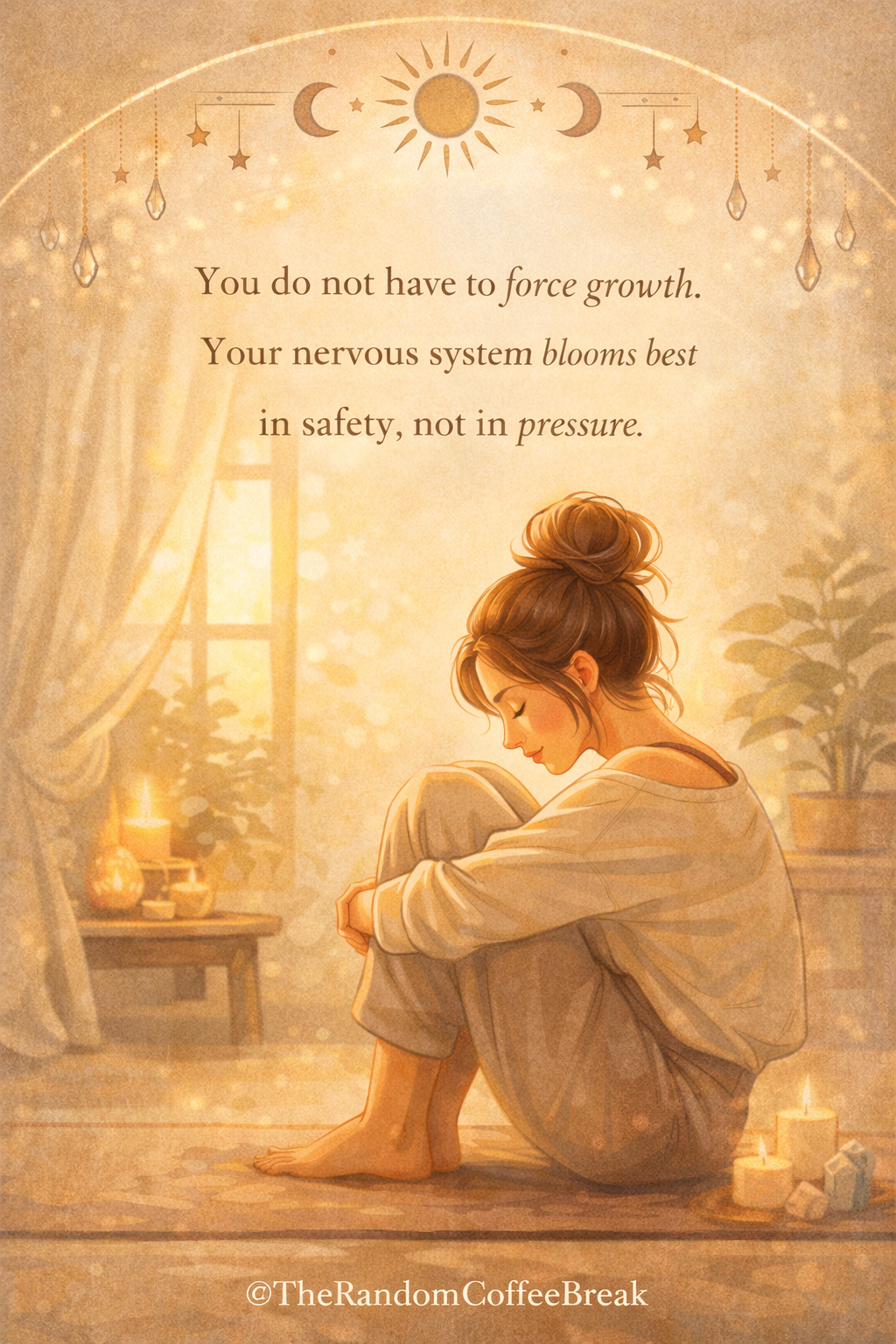
You do not have to force growth. Your nervous system blooms best in safety, not in pressure. Your protectors are not your enemies. They are tired parts of you asking to be understood. And internal healing begins the moment you say, “I am willing to understand myself without judgment.”

Tonight, let your body soften a little. Let your breath deepen by one inch. Let the page hold what you no longer want to carry alone. Take what you need. Until the next quiet cup.

— Bridget The Random Coffee Break

Disclaimer: The content provided by The Random Coffee Break is for informational and educational purposes only and is not medical or mental health advice. It is not a substitute for professional care. Please consult a qualified healthcare or mental health provider regarding your specific situation.

Before you finish this week… Pause for a second. You might be tired in a way sleep doesn’t fix. Not because you’re lazy. Not because you’re unmotivated. But because you’re holding too many invisible responsibilities. Emotional labor. Anticipation of things that are not guaranteed to happen. Being the steady one. The sounding board. Here’s a gentle reframe: Maybe you’re not behind. Maybe you’re overloaded. Today, instead of asking, “What else needs to get done?” Try asking: “What can I release?” Release the expectation to respond immediately. Release the pressure to fix someone else’s mood. Release the idea that rest must be earned and not a natural need in this life. Midweek Prompts: • What drained me so far? • What felt aligned? • What needs to wait? You don’t need a new productivity system. You might just need permission. So…. Give yourself permission.

MONDAY RESET

- Posted in Uncategorized by

This morning, I stood in the kitchen holding my coffee when the world was still quiet, and had a strange thought: When did I stop recognizing myself?

Not in a dramatic way. Not in a crisis. Just… slowly.

Somewhere between responsibilities, deadlines, being dependable, and making sure everyone else was okay — I started becoming efficient instead of present. Maybe you know that feeling.

You’re functioning. You’re productive. You’re showing up.

But something feels thinner. Quieter. Slightly disconnected.

Here’s the truth we don’t say out loud: Sometimes we don’t burn out because we’re weak. We burn out because we abandon ourselves in small, socially rewarded ways.

Let’s talk about how to gently come back.

First:
Notice Where You’re Over-Explaining When you start over-explaining your boundaries, it’s usually a sign you don’t fully believe you’re allowed to have them.

This week, experiment with shorter sentences. Instead of: “I’m so sorry, I wish I could, but it’s just been so busy…” Try: “That will not work for me this week.”

Your nervous system deserves clarity, and this can protect your peace.

Take time for reflection: Do I explain myself out of guilt instead of choice?

Second: Redefine Enough

Overwhelmed professionals often don’t lack discipline — they lack limits. Working to reach the top of a mountain that just keeps getting taller.

Ask yourself: What would “enough” look like today?

Not perfect. Not even optimal. Just enough.

Sometimes enough is replying to three emails instead of ten. Sometimes enough is leaving the dishes for tomorrow or clothes in the dryer.

Reflection Prompts: • Where am I overgiving? • What am I afraid will happen if I slow down? • What does enough look like today, not to tomorrow, just today?

You don’t have to solve tomorrow to survive today.

Just start with one honest pause...

Take what you need. Until the next quiet cup. ☕

SUNDAY SANCTUARY

- Posted in Uncategorized by

Sunday evenings can feel quiet in a way that isn’t peaceful.

The light changes. The house settles. And your mind starts rehearsing the week ahead because chaos is not off the table.

The unexpected meeting, that really could have just been an e-mail. The unwanted conversations. The overwhelming expectations.

Sometimes Sunday isn’t restful. It’s bracing.

But what if you didn’t enter this week in defensive mode? What if you entered it steadily? Let’s do something simple tonight. Step 1: Write down what you’re worried about. Don’t filter it. Just empty it out. Brain Dump it.

Step 2: Circle what is actually within your control. You’ll notice most of it isn’t, because in reality, it never was.

Step 3: Choose one grounded action for tomorrow morning. Not five. Just One. Maybe it’s arriving 10 minutes early. Maybe it’s protecting your lunch break from the office chaos. Maybe it’s not volunteering first. You are allowed to enter this week without shrinking. You are allowed to enter it without proving anything. Let tomorrow come tomorrow.

Take what you need. Until the next quiet cup. ☕

The Random Coffee Break is a space built on life experience and the shared journey of finding calm in a loud world. Please be advised that we are not medical or mental health professionals. The content shared here—including our journals, blog posts, and guides—is for personal reflection and informational purposes only.

If you are experiencing distress or require professional help, please seek the proper medical or therapeutic attention immediately. Your well-being is sacred; please treat it with the professional care it deserves.