The Random Coffee Break
slow moments • gentle clarity • quiet courage

The world moves at a pace that often feels impossible to match. You might feel as though you are constantly playing catch-up with your own life. The emails. The notifications. The quiet, persistent hum of things left undone. It is easy to believe that in order to find peace, you must first clear your schedule. That you must travel somewhere far away. Or sit in silence for an hour you do not have. But stillness does not require a mountain top. It only requires a moment. Here, we explore the idea that mindfulness is not a mountain to climb, but a small pocket of peace you can carry in your coat. A way to find your center in just three minutes. Because the world can wait for three minutes.

The weight of the "always on" world We often talk about work-life balance as if it were a scale we must perfectly level. But sometimes, the scale is broken. We feel the pressure to be productive every second. Even our rest feels like something we must optimize. This is why many of us struggle with meditation for beginners. We approach it like another task. Another thing to be "good" at. But what if meditation was simply an invitation to stop? Not to be better. Not to be "zen." Just to be here. When you feel like you’re losing yourself in the noise, these three minutes are your anchor.

Minute One: Arriving (Stillness)

The first minute is about the body. It is the act of physical arrival. You might be sitting at your desk. Or standing in line for a morning coffee. Perhaps you are sitting on the edge of your bed, feet touching the cool floor. Notice the weight of your body. How the chair holds you. How the ground supports you. You do not need to do anything to be held. Soften your shoulders. Let them drop away from your ears. Unclench your jaw. Notice if you are holding your breath. You are not "doing" meditation yet. You are simply noticing that you have a body. And that your body is right here. This is the first pillar of our practice: Stillness. It is the radical act of refusing to rush for sixty seconds.

Minute Two: Noticing (Reflection) Once the body has arrived, the mind may still be running. That is okay. Your mind is doing what it was built to do. It is trying to protect you by planning, remembering, and worrying. In this second minute, we practice Reflection. Instead of trying to stop the thoughts, simply notice them. Imagine your thoughts are like clouds passing over a field. Or steam rising from a warm mug of tea. You are the field. You are the mug. The thoughts are just passing through. Listen to the sounds around you. The distant hum of traffic. The ticking of a clock. The sound of your own breathing. Notice how the air feels as it enters your nose. Is it cool? Is it warm? You are not judging these sensations. You are simply being a witness to them. This is where slow living begins. It is the realization that the present moment is full, even when it is quiet.

Minute Three: Returning (Rebuilding) The final minute is perhaps the most important. It is the bridge between your quiet moment and the rest of your day. In our community, we call this Rebuilding. We are not just seeking a temporary escape. We are building a more intentional life, one breath at a time. As you finish these three minutes, do not rush to check your phone. Stay in the space you have created for just a few more seconds. How do you want to carry this feeling into your next hour? Perhaps you choose to move a little slower. Perhaps you choose to speak a little more gently. You are rebuilding your next chapter with every conscious choice to stay centered. Wiggle your fingers. Roll your ankles. When you are ready, gently open your eyes. You have been away for three minutes. And yet, everything feels slightly different.

Why three minutes is enough We often hear that we need twenty minutes of meditation to see results. But in an overstimulated world, twenty minutes can feel like a lifetime. Three minutes is accessible. Three minutes is honest. It is long enough to break the cycle of stress. But short enough to fit into a lunch break or a morning ritual. When we lower the barrier to entry, we make peace a habit rather than a luxury.

The beauty of the "Small Pause"

Mindfulness does not have to be a formal event. It can happen while you are washing the dishes. Feeling the warmth of the water on your hands. It can happen while you are walking to your car. Noticing the way the light hits the pavement. These small pauses are the foundation of a mindful life. They remind us that we are human beings, not human doings. They give us permission to breathe. If you find that your shadow self is asking to be heard, these moments of stillness are where you can begin to listen. Without judgment. Without fear. Just with a gentle curiosity.

Creating your environment

While you can meditate anywhere, it can be helpful to create a "warm analog" space for yourself. A place that feels soft. Think about the textures around you. A linen pillow. A wooden table. The way the light filters through a thin curtain. These natural elements ground us. They remind us of the slow, steady rhythms of the earth. When your environment is calm, your internal world often follows. But even if your environment is chaotic, remember: Your center is within you. You can find it in the middle of a crowded train. Or a noisy office. It is always there, waiting for you to notice it.

An invitation to continue

Meditation is a practice, not a destination. Some days, those three minutes will feel like a warm hug. Other days, they will feel like a struggle. Both are okay. The goal is not to be a "perfect" meditator. The goal is to show up for yourself. To say, "I am worth three minutes of my own time." Because you are. You deserve a life that feels like yours. A life where you have the space to breathe and the time to notice the light. If you are looking for a way to deepen this practice, I invite you to join our quiet community. We have a gentle guide called 7 Days of Quiet Reflection. It is a free resource designed to help you build these small pockets of peace into your daily rhythm. No pressure. No hustle. Just a gentle unfolding. You can find it here. Take your time. The world can wait. May your day be soft, and your heart be light. With warmth,

The Random Coffee Break

Take a breath. Right here, in this moment. Perhaps you are holding a warm cup of coffee. Notice the steam as it curls into the air, vanishing before it even reaches the ceiling. It is okay if you feel a little heavy today. It is okay if the world feels too loud, too fast, and too demanding. You are here. And that is enough. The Parts We Leave Behind We often spend our lives curating a version of ourselves that is easy for the world to digest. We focus on the light. The productivity. The smiles. The "I'm doing well" responses. But there are other parts of you, aren't there? There are the parts that feel "too much." The parts that feel small, or angry, or deeply, quietly sad. In the world of mindfulness, we often call these the shadow. But do not let that word frighten you. The shadow is not a monster in the closet. It is simply the collection of parts you have tucked away because you were told: by the world, by your past, or by yourself: that they didn't belong. Shadow work is not about fixing what is broken. It is about inviting those tucked-away parts to sit at the table with you. It is about meeting yourself in the quiet corners of your heart, with a cup of tea and no agenda other than to listen.

A Soft Invitation, Not a Command You might have heard that shadow work is intense. That it is a "battle" or a "deep dive" into darkness. But here at The Random Coffee Break, we believe in softer rhythms. Your nervous system is a delicate thing. It responds to pacing. If you try to force your way into your inner world, your heart might naturally close up to protect itself. Think of it like a wild bird. If you run toward it, it will fly away. But if you sit quietly on the porch, day after day, it might eventually land on the railing beside you. Inner work is the same. We do not "do" shadow work. We allow it to unfold. We soften the edges of our judgment. We notice the "fog" in our minds and, instead of trying to sweep it away, we simply sit within it until the sun comes out. Recognizing the Call How do you know when your shadow is asking for your attention? It usually doesn't shout. It whispers. You might find yourself judging someone else for a trait you secretly possess. You might feel a sudden, sharp pang of irritation at something small. You might notice a recurring pattern in your relationships that feels like walking in circles. You might feel an "invisible weight" that you can't quite name. These are not signs that you are failing. They are signals from your soul that it is time for a quiet conversation.

Creating Your Sacred Space

Before you begin this kind of inner reflection, you must build a container of safety. This is why we focus on intentional habits. Find a corner of your home that feels peaceful. Perhaps it is near a window where the morning light is soft and filtered. Light a candle. Feel the texture of the blanket on your lap. Smell the roasted beans of your coffee. When you ground yourself in the physical world, your inner world feels safer to explore. Inner work is not about leaving your body; it is about inhabiting it so fully that your "shadows" have a safe place to rest. Gentle Prompts for Your Heart If you are ready to begin, do not feel pressured to "solve" anything today. Choose just one of these invitations. Let it sit with you like a slow-steeping tea. The Judgment Mirror: What is one thing about another person that truly bothers me? If that trait were a small child inside of me, what would it be trying to protect? The Hidden Gift: What is a part of myself I usually try to hide? What would happen if I told that part, "You are allowed to be here"? The Physical Echo: When I feel "triggered" or upset, where do I feel it in my body? Is it a tightness in the throat? A weight in the chest? Just notice. The Quiet Voice: If my sadness had a voice, what is the very first word it would say to me today? Write your answers without editing. Let them be messy. Let them be "wrong." There is no one here to grade your progress. You are simply witnessing your own becoming.

A New Way to Hold Yourself

We know that this work can feel daunting when you are doing it alone. We know that sometimes, you need a hand to hold while you walk through the fog.

This is why we have been working quietly behind the scenes on something special for you. Our Shadow Work Journal is launching this Thursday, May 14th. It will be available right here on our website and through our Gumroad shop. This gentle 34-page guide will be available for $6.50. We have intentionally kept the price low because we believe shadow work is an integral part of understanding ourselves and our mental health.

It should not feel like a luxury. It should feel like a tool within reach. It isn't a book of "fixing." It is a collection of soft invitations, rhythmic reflections, and gentle spaces for you to meet yourself: all of yourself: with compassion. It is designed for the overwhelmed, the burnt-out, and the seekers who are tired of hustle culture. It is a permission slip to move slowly.

A Quiet Companion for Your Journaling Session

If you are planning to sit down with your journal on Thursday, May 14th, we made something cozy for you. Our new YouTube video, Cozy Rainy Night Ambience ☕ Thunderstorm Sounds for Sleep, Study, Relaxation & Journaling, is releasing that day as well. It is a gentle companion piece for your reflection time. You can let the soothing sounds of a thunderstorm fill the room while you write. And if you love our signature "Model-T" rainy night aesthetic, this one was made with that same soft, familiar feeling in mind.

The World Can Wait

As you move through the rest of your day, remember this: The world can wait for five minutes. The emails can wait. The chores can wait. Your inner peace is the foundation upon which everything else is built. When you meet your shadows with kindness, they stop being obstacles and start being guides. They show you where you need more rest. They show you where you have been neglecting your own joy. They show you that you are much more whole than you ever realized.

Be gentle with yourself today. You are doing brave work just by existing in this loud world. You are not "too much." You are not "not enough." You are a beautiful, complex person navigating a human life. And that is a miracle in itself. Keep your light soft. Keep your heart open. And don't forget to take your random coffee break.

With love and stillness, The Random Coffee Break Team

There is a specific kind of silence that only arrives when the world is still waking up. It is a soft, blue-gray silence. The kind that doesn’t demand anything from you. In our first part of this series, we spoke about the initial pause. The moment you decide to stop running. But once you have stopped, what happens next? How do we begin to listen to the whispers that were drowned out by the noise? We call this phase the Slow Rebuild. It is not a construction site. There are no hard hats here. No deadlines. No blueprints that cannot be changed. Instead, it is a gentle rearranging of the furniture inside your soul. It is about finding where the light hits. And it begins with a single, tactile choice.

The Weight of the Page

We live in a world of glass and light. Our fingers tap on screens that offer no resistance. There is a speed to digital life that bypasses the heart. When you type, your thoughts can move as fast as a spark. But when your thoughts move that fast, they often don't have time to settle. They stay on the surface. This is why we invite you back to the ritual of the analog. There is a profound medicine in the physical weight of a journal. The way it sits on your lap, solid and expectant.

When you open our The Spirituality Journal you are not just opening a book. You are opening a door. Notice the texture of the paper beneath your fingertips. It is slightly toothy. It has a grain. It is waiting for you to leave a mark that cannot be erased with a thumb-press. There is something revolutionary about a mark that stays.

The Scratch of the Pen

Have you ever truly listened to the sound of a pen moving across paper? It is a rhythmic, grounding sound. A tiny, dry friction. It is the sound of a thought becoming a physical thing. In the digital world, your words are pixels. They are made of light. But in your journal, your words are made of ink and pressure. They have a scent. They have a shadow. When you write by hand, your brain is forced to slow down to the speed of your wrist. You cannot outrun yourself when you are holding a pen. You have to wait for the letters to form. You have to watch the ink dry. This delay is where the magic happens. In that micro-second of waiting, you find clarity. You notice the way your hand trembles when you write something difficult. You notice the way your handwriting rounds out and softens when you feel at peace.

The Nonna-Maxxing Revolution

Lately, we have been thinking a lot about what people are calling the "Nonna-Maxxing Revolution." It is a playful term for a very deep longing. It is the desire to live like our grandmothers did. To bake the bread. To mend the clothes. To sit by the window and simply watch the rain. It is a rejection of the "hustle" in favor of the "hum." The hum of the kettle. The hum of a quiet house. On The Random Coffee Break TV YouTube channel, you can also find relaxing ambient soundscapes and gentle ASMR. Rain against the window. A crackling fire. Quiet audio made especially for journaling and meditation. It is a soft companion for the moments when you want to return to a gentler, more human pace. Our ancestors weren't "behind the times." They were simply in sync with a human pace. They didn't have notifications to tell them they were falling behind. They had the seasons. They had the rising sun. When we embrace analog habits, we are nonna-maxxing our mental health. We are choosing the slow way because the slow way is the only way the soul can keep up.

Reflections for the Quiet Moments

If you are feeling the "fog" today, don't fight it. The fog is just a sign that you need to find your center. Find a wooden surface. A kitchen table. A desk by a window. A park bench. Open your journal and let your pen rest on the page for a moment. Don't feel the need to perform. Don't feel the need to be "profound." Just notice. Here are a few quiet invitations for your next session: What does the air feel like against your skin right now? If your current energy was a color, what shade would it be? What is one thing your body is trying to tell you that you’ve been too busy to hear? What would happen if you did "less" today? Notice how your body reacts to that last question. Does your chest tighten? Does your breath catch? That is the "hustle" trying to protect its territory. Breathe into that space. Tell that part of you that it’s okay to rest.

The Softened Rhythm

We often think that to "rebuild," we need to be strong. We think of steel and stone. But a slow rebuild is more like a garden. It requires softness. It requires the ability to bend without breaking. It requires the patience to watch things grow at their own speed.

When you sit with your coffee and your journal, you are gardening your inner world. You are pulling the weeds of "should" and "must." You are planting the seeds of "I am" and "I feel." This is not a quick fix. It is a sustainable practice. It is a way of saying to yourself: "I am worth the time it takes to understand me."

A Look Ahead: The Quiet Exit

As we move through this rebuilding phase, we are preparing for something special. On May 3rd, we will be launched "The Quiet Exit." It is a new collection and a new philosophy. It is about how we leave the spaces that no longer serve us. How we walk away from the noise without slamming the door. How we exit the "always-on" culture with grace. You can read more about the heart behind this in our recent post: The Quiet Exit: A Gentle Rebuilding for Your Next Chapter. It is an invitation to choose a different path. A softer path.

The Invitation

Before you close this tab and return to the digital stream. Pause. Take a deep breath. Feel the floor beneath your feet. If you have a journal nearby, perhaps write down one word. Just one. How do you feel in this exact second? Not how you want to feel. Not how you think you should feel. But the truth of the moment. Carry that truth with you. It is the most honest thing you own.

The world can wait for five minutes. It really can. And in those five minutes, you might just find the piece of yourself you’ve been looking for.

Take what you need. Until the next quiet cup.

You have been running for a long time. Perhaps you didn’t notice the pace at first. It started as a light jog. A series of deadlines. A few extra notifications. The hum of the office. The chime of the email. And then, slowly, the world became very loud. You are not broken. You are simply full. You are full of voices that are not your own. Full of expectations that don't fit the shape of your soul. Full of a "hustle" that has left you hollow. Maybe you are sitting at your desk right now. Your eyes are heavy. The screen is a blur of blue light and demands. You feel a tug. A quiet pull toward the door. Toward the window. Toward a life that feels like yours again. This is the beginning of your quiet exit.

The Fog of the Constant Connection

Burnout is not a wall. It is a fog. It settles in the corners of your room. It sits in the bottom of your coffee cup. It makes the simplest tasks feel like walking through deep water. You might feel like you are losing your grip on the things you once loved. You might feel like you are losing yourself. We want you to know: It is okay to be tired. It is okay to want out.

The "Quiet Exit" is not about a dramatic resignation. It is not about burning bridges. It is about a soft withdrawal from the noise. It is an invitation to stop giving your energy to things that do not give it back. Notice how your body feels when you think about "doing less." Does your chest tighten? Or does it finally, for a moment, soften? Listen to that softness. An Invitation to Stillness

At The Random Coffee Break, we believe in the power of the pause. We believe that a warm mug held in two hands is a sacred thing. The steam rising. The warmth seeping into your palms. The world slowing down to the speed of a sip. This is where the rebuilding begins. Not in the grand plans for a new career. Not in the five-year strategy. But in the stillness of this morning. Stillness is not laziness. Stillness is the soil where clarity grows. When you sit still, the silt in the water of your mind begins to settle. The clouds begin to part. And eventually, life starts to come back into focus. You do not need to have the answers today. You only need to have the breath. Inhale. Notice the cool air. Exhale. Notice the release. The world can wait for five minutes. Truly. It can. The emails will stay in the inbox. The projects will remain on the list. The expectations of others will linger. But for these five minutes, you belong to yourself. Introducing: The Calming Journal

We made something gentle for you. For the dreamers who are tired. For the achievers who are empty. For the creatives who have lost their spark. The Calming Journal is now live. It is available now in our website (www.TheRandomCoffeeBreak.com) and on Gumroad. This is not a "productivity" workbook. It will not tell you how to "optimize" your exit. It will not give you a checklist for a six-figure pivot. Instead, it is a collection of quiet practices. A series of reflective prompts. A map for returning to your own center. It is built upon our three pillars: Stillness: Learning to sit with the silence until it feels like a friend. Reflection: Identifying the "noise" that has been masquerading as your own voice. Rebuilding: Creating intentional habits that honor your energy, not just your output. This workbook is designed for the moments between. The moments when you are transitioning from the corporate world. The moments when you are closing one chapter and haven't yet opened the next. It is a soft place to land. Softness with Structure

We know that "slowing down" can feel terrifying. When you have been defined by your "doing," "being" feels like a risk. You might fear that if you stop, you will never start again. You might fear that you will be forgotten. The Quiet Exit is about building a structure of softness. It is about morning rituals that ground you. It is about evening reflections that clear the day. It is about listening to the parts of yourself that have been whispered away. In the workbook, you will find: Quiet prompts for morning light. Gentle movement invitations for tired bodies. Space to mourn what you are leaving behind. Guided stillness for when the anxiety rises. We want to help you rebuild. But we want you to rebuild slowly. Brick by brick. Breath by breath. There is no rush to the finish line. The finish line is an illusion anyway.

Your First Quiet Practice

You do not have to wait to begin. You can begin right now. Set down your phone. Close your eyes. Or soften your gaze on something neutral. Notice the weight of your body in the chair. The way the floor supports your feet.

Ask yourself: What is one thing I am carrying that is not mine? Maybe it is a boss's frustration. Maybe it is a parent's expectation. Maybe it is a society's definition of success. Imagine yourself setting it down. Just for a moment. Like a heavy bag at the end of a long walk. You don't have to throw it away yet. Just notice how it feels to let your shoulders drop. This is the work. This is the rebuilding.

A Note on the Journey Ahead We are so glad you are here. The world needs more people who have dared to slow down. More people who have chosen softness over the grind. More people who have taken a quiet exit. You are part of a community that understands. A community that knows that taking a break isn't lazy. It is revolutionary self-care.

If you have been waiting for a softer way to begin again, this is your invitation. You can meet this next chapter with a little hope. A little steadiness. A little more room to breathe. Your next chapter is unfolding. And it is allowed to be gentle. The world can wait for five minutes. But your soul has waited long enough.

Softly, The Random Coffee Break Team

The world moves very fast. Sometimes, it feels like it moves faster than we were ever meant to go. You wake up, and the noise is already there. The hum of the phone. The weight of the to-do list. The feeling that you are already behind, even before your feet have touched the floor. We live in a culture that treats "busy" like a badge of honor. We are told that to be still is to be lazy. We are told that every second must be optimized, squeezed, and used. But what if we tried something different? What if we gave ourselves the permission to simply... stop? Not forever. Just for a moment. A slow, deliberate moment.

What is a Slow Moment?

A slow moment is not a task to be completed. It is not something you "do" so you can be more productive later. It is a pause that exists for its own sake. It is the act of noticing the steam rising from your coffee. It is the way the light stretches across the wooden floor in the afternoon. It is the feeling of your own breath, steady and quiet, in a room that is finally still. When we allow for these moments, we are not losing time. We are reclaiming ourselves. We are telling our nervous systems that, for right now, the world can wait. And the world always waits. It will be there when you return. But you will return to it differently. You will return with a heart that has had a chance to soften.

Embracing the "Nonna-Maxxing" Way

Lately, we have been talking about a philosophy we like to call "Nonna-Maxxing." It is a gentle way of looking at the world. It is about finding the joy in the analog rhythms of life. Think of a grandmother in a quiet kitchen. She is not rushing. She is not checking her notifications while the water boils. She is present with the dough. She is present with the sunlight on the countertop. Nonna-Maxxing is an invitation to bring that same intentionality into your own day. It is about trading the digital scroll for the weight of a book. It is about choosing the "softer rhythms" over the hustle. It is about understanding that some things: the best things: take time to unfold. When you practice a slow moment, you are practicing a form of revolutionary self-care. You are saying that your peace is more important than the algorithm. You are saying that you deserve to exist without being "useful."

Creating Your Sanctuary with Sound

One of the hardest parts of slowing down is the silence. For many of us, silence feels loud. It feels like a space that needs to be filled with noise, podcasts, or scrolling. But there is a middle ground between the chaos of the world and the heavy silence of an empty room. There is the sound of the earth. At The Random Coffee Break, we believe that our environment dictates our internal state. If your environment is cluttered with noise, your mind will feel cluttered, too. This is why we created The Random Coffee Break TV on YouTube. It is a place where you can find soothing nature sounds designed to anchor you in the present. The sound of rain against a window. The gentle rustle of leaves in a forest. The soft crackle of a fireplace in a dim room. These are not just background noises. They are invitations to come back to yourself. They provide a "container" for your slow moment. When you play these sounds, you are signaling to your brain that it is safe to let go. You are creating a sanctuary, right where you are. Whether you are journaling, drinking tea, or simply sitting in stillness, let the sounds of nature guide you back to a pace that feels natural.

How to Invite a Slow Moment Into Your Day

You do not need a mountain retreat to find peace. You do not need an hour of meditation. You only need five minutes and a willing heart. Here are a few quiet practices you might consider: The Morning Light Ritual: Before you reach for your phone, sit by a window for five minutes. Just watch the sky. Notice the colors. Let the light be your first input of the day.

The Sensory Sip: When you have your coffee or tea, do nothing else. Feel the warmth of the mug in your palms. Smell the steam. Notice the first sip.

The Analog Evening: Turn off your screens an hour before bed. Light a candle. Listen to the nature sounds on our YouTube channel. Let your eyes rest.

The Intentional Task: Pick one chore: like washing the dishes or folding laundry: and do it slowly. Focus on the temperature of the water or the texture of the fabric.

Notice how your body reacts when you slow down. You might feel a sense of resistance at first. That is okay. You are unlearning years of rushing. Be gentle with yourself as you learn to be still.

A Moment of Reflection

Take a breath. Right now, as you read this. Feel the air fill your lungs. Feel the weight of your body against your chair. Ask yourself these questions, softly and without judgment: What is my body trying to tell me right now? Where am I holding tension that I can let go of? What would it feel like to be five percent slower today? What is one thing I am grateful for that doesn't cost anything? There are no wrong answers. There is only the act of listening.

The Quiet Exit

We are all moving toward something. But sometimes, the most important journey is the one that leads us back to our own center. As we prepare for the launch of our new workbook, "The Quiet Exit," on May 3rd, we want to encourage you to start making your own small exits every day. Exit the noise. Exit the rush. Exit the expectation that you must be everything to everyone at all times. You are allowed to be quiet. You are allowed to be slow. You are allowed to just be. The world can wait for five minutes. And in those five minutes, you might just find everything you've been looking for.

Stay gentle with yourself. We are all in this together.

With warmth and stillness, Bridget The Random Coffee Break

If you’re feeling overwhelmed, you might find comfort in our recent post on what to do when you feel like you’re losing yourself. You aren’t alone.

The world is very loud right now. Perhaps you feel it too. It is a hum that never quite stops. It lives in the pocket of your jeans, buzzing with the thoughts of a thousand strangers. It vibrates in the glow of your laptop at midnight. It whispers that you are behind, that you are missing something, that you must run faster just to stay in the same place. We call this the noise. It is not just sound. It is the weight of constant connectivity. It is the pressure to be productive at the expense of being present. If you are feeling burnt out, you are not failing. You are simply a human being living in a world designed for machines. You are allowed to want something different. You are allowed to step away from the hum. This is your invitation to slow living. It is not a trend or a quick fix. It is a gentle returning to yourself.

The Fog of the Fast Life We often live our lives in a sort of digital fog. We scroll through feeds before our eyes have fully adjusted to the morning light. We eat our lunch while typing emails, never truly tasting the bread or the fruit. We walk through the park with headphones on, blocking out the sound of the wind in the leaves. When we live this way, our focus becomes fragmented. It is like a mirror that has been dropped. We see ourselves in a hundred tiny, sharp pieces. We lose the ability to sit with a single thought. We lose the ability to listen to the quiet messages our bodies are sending us. Do you remember the last time you sat for ten minutes without a screen? Did it feel uncomfortable? That discomfort is not a sign that you are doing something wrong. It is the sound of your nervous system trying to find its way back to a softer rhythm. It is the first step toward reclaiming the parts of yourself that have been hidden by the noise.

Pillar One: Reflection

Before we can change the pace of our lives, we must notice the pace we are currently keeping. This is the practice of reflection. It is not about judging your habits. It is about looking at them with a kind of soft curiosity. Imagine you are watching clouds move across a grey sky. You are simply noticing. Notice the first thing you reach for when you wake up. Notice the way your shoulders tighten when you hear a notification chime. Notice the "shoulds" that play on a loop in your mind. Notice the moments when you feel most like yourself. Reflection is the act of creating space between the noise and your reaction to it. It is asking yourself: What am I actually hungry for? Sometimes, we think we are hungry for a new purchase or a new achievement. But often, we are just hungry for a moment of quiet. We are hungry for a sense of belonging in our own lives. When you begin to reflect, the fog starts to thin. You might start to see the signs that your deeper self is asking to be heard. Listen to those signs. They are the compass that will lead you home.

Pillar Two: Stillness

Stillness is a revolutionary act. In a culture that equates busyness with worth, choosing to do nothing is a form of protest. But stillness is not just about physical inactivity. It is about finding the gap. There is a gap between the inhale and the exhale. There is a gap between the moment the sun sets and the moment the stars appear. There is a gap between the world’s demands and your response. You can find stillness in the steam rising from your morning coffee. You can find it in the rhythm of washing the dishes. The water is warm. The soap is soft. The task is simple. In these moments, you are not a "user" or a "consumer" or a "brand." You are a person holding a plate. You are a person breathing. Slow living invites you to anchor your day in these small, sensory rituals. These are not chores. They are touchstones. They remind your brain that you are safe, that you are here, and that the world can wait for five minutes.

Pillar Three: Rebuilding

Once you have reflected and found a bit of stillness, you can begin to rebuild. Rebuilding is not about adding more to your plate. It is about choosing what stays and what goes. It is about creating "softer rhythms." This might look like setting a digital sunset. At 8:00 PM, the screens go dark. The blue light fades. The room softens. You might choose to engage in "monotasking." When you are walking, just walk. When you are talking to a friend, just listen. When you are reading, just read. It feels strange at first. Your mind will want to wander back to the noise. Gently, like you are leading a small child by the hand, bring it back. Rebuilding is a slow process. It is like tending a garden in the early spring. There is a lot of waiting. There is a lot of trust. You are planting the seeds of a more intentional life. You are building a world where your life can finally come back into focus.

Simple Invitations for Your First Week If you are wondering where to start, do not feel pressured to do everything at once. Slow living is not a race. Here are a few quiet invitations for you to explore: The Three-Breath Rule: Before you open any app on your phone, take three deep, slow breaths. Notice the texture of the air. Notice the weight of the phone in your hand. The Analog Morning: Keep your phone in another room for the first thirty minutes of your day. Watch the light change on the wall instead. The Sensory Check-In: Once an hour, ask yourself: What do I hear? What do I smell? What does the floor feel like beneath my feet? The Gentle "No": Practice saying no to one thing this week that feels like "noise." It could be a meeting, a social commitment, or even a podcast you feel obligated to finish. These small shifts are where the magic happens. They are the way you tell yourself that your time is your own. They are the way you protect your focus.

Reclaiming the Quiet

Choosing to slow down will not make the world less chaotic. The noise will still be there. The notifications will still come. But you will be different. You will have a place inside yourself that remains quiet. You will have a home to return to when the hum becomes too loud. You are not "lazy" for needing a break. You are not "unproductive" for wanting to sit in the sun for twenty minutes. You are human. And humans were meant to unfold slowly, like a flower, not to be processed like data. If you find yourself needing tools to support this journey, we have gathered a few gentle things in our MindEssentialDesigns shop to help you create a more peaceful environment. But remember, the most important tool you have is already within you. It is your breath. It is your attention. It is your willingness to pause. The world can wait. You are here. And that is enough. Take a gentle breath. You are doing just fine. Softly, The Random Coffee Break

You have been running for a long time. Perhaps you didn’t notice the pace at first. It started as a light jog. A series of deadlines. A few extra notifications. The hum of the office. The chime of the email. And then, slowly, the world became very loud. You are not broken. You are simply full. You are full of voices that are not your own. Full of expectations that don't fit the shape of your soul. Full of a "hustle" that has left you hollow. Maybe you are sitting at your desk right now. Your eyes are heavy. The screen is a blur of blue light and demands. You feel a tug. A quiet pull toward the door. Toward the window. Toward a life that feels like yours again. This is the beginning of your quiet exit. The Fog of the Constant Connection

Burnout is not a wall. It is a fog. It settles in the corners of your room. It sits in the bottom of your coffee cup. It makes the simplest tasks feel like walking through deep water. You might feel like you are losing your grip on the things you once loved. You might feel like you are losing yourself. We want you to know: It is okay to be tired. It is okay to want out. The "Quiet Exit" is not about a dramatic resignation. It is not about burning bridges. It is about a soft withdrawal from the noise. It is an invitation to stop giving your energy to things that do not give it back. Notice how your body feels when you think about "doing less." Does your chest tighten? Or does it finally, for a moment, soften? Listen to that softness. An Invitation to Stillness

At The Random Coffee Break, we believe in the power of the pause. We believe that a warm mug held in two hands is a sacred thing. The steam rising. The warmth seeping into your palms. The world slowing down to the speed of a sip. This is where the rebuilding begins. Not in the grand plans for a new career. Not in the five-year strategy. But in the stillness of this morning. Stillness is not laziness. Stillness is the soil where clarity grows. When you sit still, the silt in the water of your mind begins to settle. The clouds begin to part. And eventually, life starts to come back into focus. You do not need to have the answers today. You only need to have the breath. Inhale. Notice the cool air. Exhale. Notice the release. The world can wait for five minutes. Truly. It can. The emails will stay in the inbox. The projects will remain on the list. The expectations of others will linger. But for these five minutes, you belong to yourself. Introducing: The Quiet Exit Workbook

We have been working on something gentle for you. For the dreamers who are tired. For the achievers who are empty. For the creatives who have lost their spark. On Sunday, April 19th, we are releasing The Quiet Exit: A Guide to Gentle Rebuilding. This is not a "productivity" workbook. It will not tell you how to "optimize" your exit. It will not give you a checklist for a six-figure pivot. Instead, it is a collection of quiet practices. A series of reflective prompts. A map for returning to your own center. It is built upon our three pillars: Stillness: Learning to sit with the silence until it feels like a friend. Reflection: Identifying the "noise" that has been masquerading as your own voice. Rebuilding: Creating intentional habits that honor your energy, not just your output. This workbook is designed for the moments between. The moments when you are transitioning from the corporate world. The moments when you are closing one chapter and haven't yet opened the next. It is a soft place to land. Softness with Structure

We know that "slowing down" can feel terrifying. When you have been defined by your "doing," "being" feels like a risk. You might fear that if you stop, you will never start again. You might fear that you will be forgotten. The Quiet Exit is about building a structure of softness. It is about morning rituals that ground you. It is about evening reflections that clear the day. It is about listening to the parts of yourself that have been whispered away. In the workbook, you will find: Quiet prompts for morning light. Gentle movement invitations for tired bodies. Space to mourn what you are leaving behind. Guided stillness for when the anxiety rises. We want to help you rebuild. But we want you to rebuild slowly. Brick by brick. Breath by breath. There is no rush to the finish line. The finish line is an illusion anyway. Your First Quiet Practice You do not have to wait until Sunday to begin. You can begin right now. Set down your phone. Close your eyes. Or soften your gaze on something neutral. Notice the weight of your body in the chair. The way the floor supports your feet. Ask yourself: What is one thing I am carrying that is not mine? Maybe it is a boss's frustration. Maybe it is a parent's expectation. Maybe it is a society's definition of success. Imagine yourself setting it down. Just for a moment. Like a heavy bag at the end of a long walk. You don't have to throw it away yet. Just notice how it feels to let your shoulders drop. This is the work. This is the rebuilding. A Note on the Journey Ahead We are so glad you are here. The world needs more people who have dared to slow down. More people who have chosen softness over the grind. More people who have taken a quiet exit. You are part of a community that understands. A community that knows that taking a break isn't lazy. It is revolutionary self-care. We invite you to join us on Sunday. The Quiet Exit: A Guide to Gentle Rebuilding will be available on our Etsy shop (The Random Coffee Break) and on Gumroad. Mark your calendar for April 19th. Prepare your favorite tea. Find a quiet corner. Your next chapter is unfolding. And it is allowed to be gentle. The world can wait for five minutes. But your soul has waited long enough. Softly, The Random Coffee Break Team

1. Strong Emotional Reactions That Surprise You

Sometimes a situation triggers a reaction that feels bigger than the moment itself. You may notice yourself feeling unusually: • defensive • hurt • angry • embarrassed even when the situation seems small. These moments are often clues that something deeper is being touched — perhaps an old experience, belief, or unmet need that was never fully processed. Your shadow isn’t trying to embarrass you. It may simply be saying: "There is something here that still needs care." Instead of pushing the feeling away, it can help to gently ask: “Why did this affect me so strongly?”

**

2. Patterns That Keep Repeating in Relationships

** Another sign of the shadow speaking is recurring emotional patterns. You may notice situations that feel familiar: • always over-giving • struggling to set boundaries • feeling unappreciated • attracting similar relationship dynamics These patterns are rarely random. Often they formed earlier in life as ways to adapt, survive, or gain approval. Shadow work invites you to look at these patterns not with blame, but curiosity. Sometimes the question becomes: “What part of me learned to operate this way?”

**

3. Judging or Reacting Strongly to Traits in Others

** One of the most surprising places the shadow appears is in the traits that bother us most in other people. For example, you might feel irritated by someone who seems: • selfish • overly confident • emotional • attention-seeking Sometimes this reaction reveals something deeper. It may point to a part of yourself that was once criticized, suppressed, or never allowed expression.

For instance: A person criticized for being “too much” as a child may feel triggered by confident people later in life. The shadow doesn’t mean you secretly are those traits. It simply means there may be an unexamined story connected to them.

**

A Quiet Reminder

** Your shadow is not a flaw. It is simply the collection of experiences, emotions, and parts of yourself that never had a safe place to exist. When these parts begin to surface, it is often not a sign that something is wrong. It may be a sign that you are becoming ready to understand yourself more honestly. And sometimes the first step is simply listening.

☕ Take what you need. Until the next quiet cup, The Random Coffee Break

There are parts of us we learn to hide. Not because they are bad. Not because they are broken. But because somewhere along the way, the world suggested they were too much.

Too emotional. Too sensitive. Too angry. Too needy. Too quiet. Too different.

So we tuck those pieces away like old letters in the back of a drawer — hoping that if we do not look at them, they will simply disappear. But they do not disappear.

They wait. This is where shadow work begins. Not as punishment. Not as self-criticism. But as a gentle invitation to turn the light back on.

What Shadow Work Really Means

In psychology, the “shadow” refers to the parts of ourselves we learned to suppress — often in childhood or during painful life experiences. These parts might include: • anger we were told was unacceptable • needs that were ignored • boundaries we were never allowed to have • grief that was never processed • dreams we were discouraged from pursuing

Shadow work is the process of meeting these hidden parts with curiosity instead of judgment. It is not about fixing yourself. It is about remembering yourself. Often, what lives in the shadow is not darkness at all — but pieces of your original self that were simply forced into hiding.

Why the Shadow Feels So Uncomfortable

Many people avoid shadow work because it can feel unsettling at first. Looking inward can reveal emotions we have spent years trying to outgrow, outrun, or outwork. But those emotions are not enemies. They are unfinished conversations within us. Anger might be the voice of a boundary that was crossed. Jealousy might reveal a dream you abandoned. Fear might point to a place where you once felt powerless. The shadow does not appear to shame you. It appears to be witnessed. And strangely, once it is acknowledged, its grip often softens.

**

The Gentle Way to Begin

** Shadow work does not have to be dramatic or overwhelming. It can begin quietly — often with something as simple as a journal and a few honest questions.

You might start by asking yourself: • What emotions do I judge most harshly in myself? • When do I feel triggered or defensive? • What traits in others bother me deeply? • What part of myself do I try hardest to hide? These questions are not accusations. They are doorways. And behind each doorway is a deeper understanding of who you are.

**

Compassion Is the Real Work

** One of the biggest misconceptions about shadow work is that it is about confronting darkness. In reality, it is about offering compassion to the parts of you that never received it. The child who felt unheard. The version of you who stayed too long. The person who carried more responsibility than they should have. Shadow work is not about digging endlessly into pain.

It is about saying: "I see you now. You don't have to hide anymore." And often, the moment you do that, healing begins.

**

A Quiet Truth

** The parts of you living in the shadow are not enemies of your growth. They are protectors who never learned they could rest. When you listen to them with patience instead of resistance, they slowly begin to trust you again. And the energy it once took to keep those parts hidden becomes available for something new. Clarity. Peace. Self-trust.

**

A Gentle Reminder

** You do not have to rush this process. Shadow work is not a race toward perfection. It is a slow unfolding of honesty, curiosity, and compassion. Some days it may look like deep reflection. Other days it may simply look like noticing a feeling without pushing it away. Both are progress. Both are healing.

**

A Quiet Coffee Break Reflection

** Tonight, or tomorrow morning with your coffee, you might ask yourself one small question: What part of me has been waiting to be understood? You do not need to solve it all at once. Just listen. Sometimes the most powerful healing begins the moment we stop abandoning ourselves.

☕ Take what you need. Until the next quiet cup, The Random Coffee Break

There are parts of us that quietly shape our lives. Not the parts we show easily. Not the strengths we celebrate. But the parts we learned to hide. The emotions we pushed aside. The needs we were told were too much. The truths we didn’t feel safe enough to speak. In the world of personal growth, these hidden pieces are often called the shadow.

But shadow work is not about searching for darkness inside yourself. It is about gently turning the light back on. Over the next few posts on The Random Coffee Break, we will explore a quiet journey inward — one that many people sense they need but rarely know how to begin.

Not in a dramatic or overwhelming way. Just slowly. Honestly. With the same patience you might bring to a long conversation with a trusted friend.

Here is the path we’ll walk together: ☕ Shadow Work Understanding the hidden parts of ourselves that influence our reactions, relationships, and inner world.

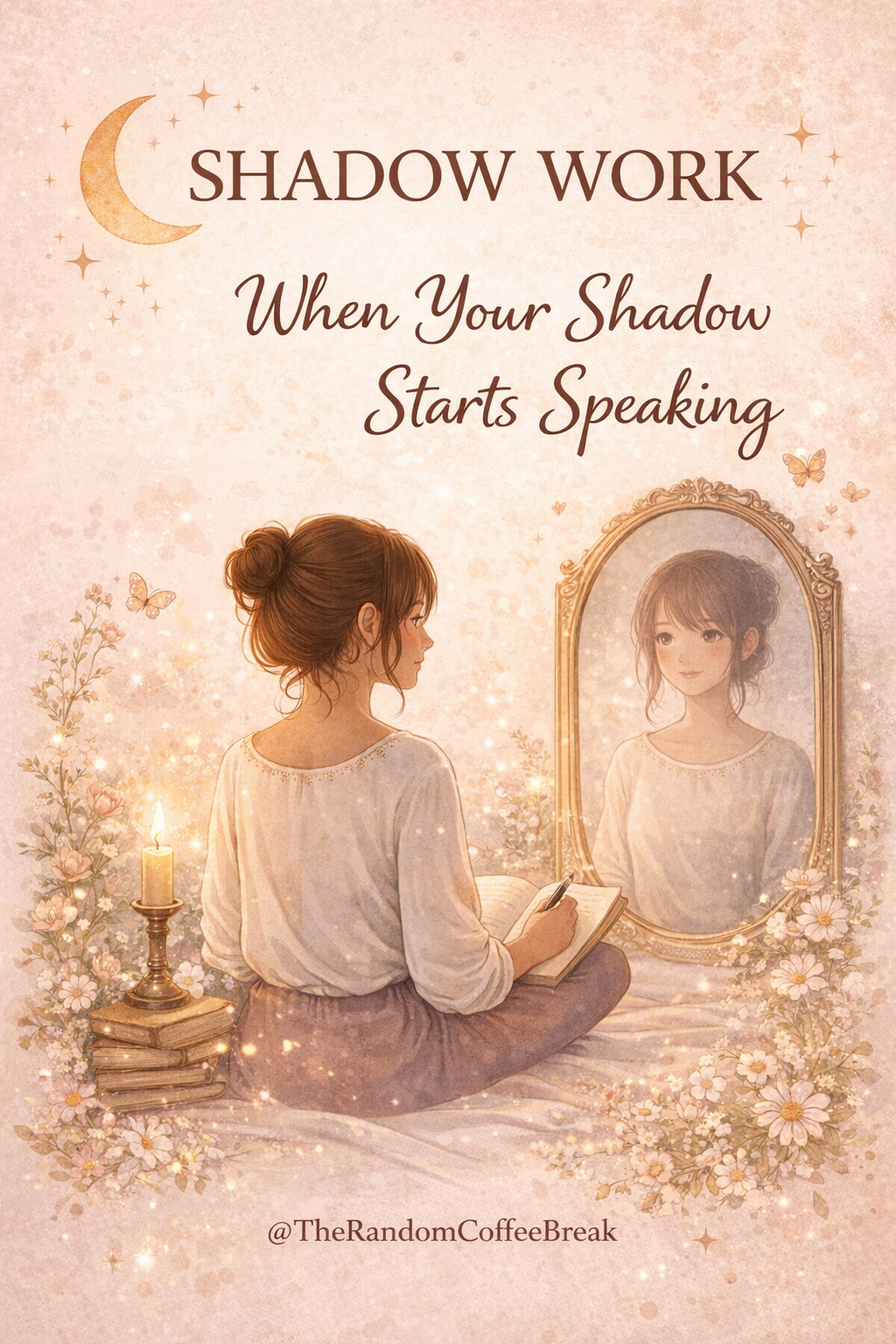
☕ When Your Shadow Starts Speaking Recognizing the moments when buried emotions or patterns begin asking for attention.

☕ Making Peace With Your Shadow Learning how compassion — not criticism — helps integrate the parts of ourselves we once rejected. ☕ The Gifts Hidden in Your Shadow Discovering how the traits we once suppressed often carry the seeds of our greatest strengths.

☕ When the Old Version of You Starts to Fall Away Navigating the strange and sometimes emotional transition when growth begins to reshape our identity.

☕ The Quiet Confidence That Comes After Shadow Work The calm, grounded self-trust that slowly grows when we stop abandoning ourselves.

This series is not about fixing who you are. It is about understanding yourself more deeply. And sometimes, the simple act of understanding is what begins the healing. If you’ve ever felt like parts of your story were left unexplored… or like certain emotions still linger beneath the surface… this may be a gentle place to begin.

No pressure. No expectations.

Just a quiet invitation to look inward with curiosity instead of judgment. If any of these reflections resonate with you, I invite you to visit the blog this week and read along.

And if you feel comfortable, you might even bring a journal with you. Sometimes the most meaningful discoveries happen in the quiet spaces between our thoughts.

Until the next quiet cup, The Random Coffee Break

The Random Coffee Break is a space built on life experience and the shared journey of finding calm in a loud world. Please be advised that we are not medical or mental health professionals. The content shared here—including our journals, blog posts, and guides—is for personal reflection and informational purposes only.

If you are experiencing distress or require professional help, please seek the proper medical or therapeutic attention immediately. Your well-being is sacred; please treat it with the professional care it deserves.